
TheRoundup is reader-supported. We may earn a commission when you make a purchase via links on this site, at no cost to you.
All products are reviewed in accordance with our Review Methodology.

Biodegradable golf balls are made from non-toxic materials such as polyvinyl alcohol (PVA) or corn starch that dissolve completely in water.
This matters because golf has an environmental problem. I was shocked when a greenkeeper friend recently told me that golfers lose up to 3 billion golf balls worldwide every year. Traditional gold balls take between 100 and 1,000 years to break down in the environment, and leach microplastics and harmful heavy metals like zinc into the soil and water.
It means that even wayward golfers (like me) can afford to lose balls in lakes, rivers, hedgerows, and woodlands without worrying about harming wildlife and local ecosystems.
You can even hit them off a boat or yacht and feed the fish instead of killing them!
This year I've taken to the course to test the best eco-friendly golf balls in the US. It’s just a shame none of them can help with my chronic hook off the tee!
✔ Best Performing Biodegradable Ball
✔ Certified Biodegradable & Non-Toxic
✔ Made in the USA
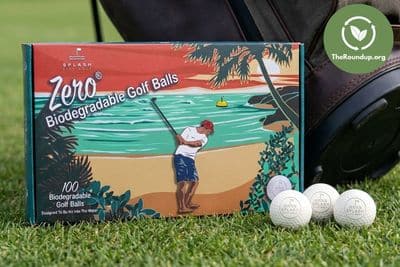
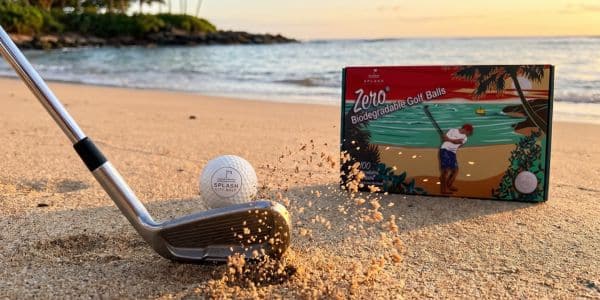
Why I Recommend It: The Zero® Ball is the highest performing biodegradable golf ball I've ever tested. Independent robotic testing by Golf Laboratories, Inc. recorded a Driver carry of 196.6 yards (179.8 m), and it's certified biodegradable and non-toxic by RespirTek using OECD 301B methodology. For the first time, you don't have to choose between sustainability and a ball that actually flies.
Personal Experience: I've been waiting years for someone to crack the biodegradable performance problem, and Splash City Golf has finally done it.
The numbers tell the story. In independent testing, using a robotic golf arm at a 95 MPH (153 km/h) club head speed, the Zero® Ball produced a Driver carry of 196.6 yards (179.8 m). That beats the next-best biodegradable ball (a Chinese-made PVA ball) by nearly 10 yards (9.1 m), and outpaces the Albus Ecobioball by almost 60 yards (54.9 m).
Just as importantly, the Driver dispersion came in at 291.7 yards (266.7 m), versus more than 2,000 yards (1,829 m) for the China ball. That's the difference between hitting a fairway and losing the ball over a fence.
When I was hitting these golf balls near water with my brother-in-law on a recent trip, the difference was immediately obvious. They feel solid off the clubface, much closer to a regular ball than the spongy, knuckleball sensation I get with other dissolvable options. My five iron shots in particular were noticeably crisp (Golf Labs measured a five iron carry of 114.8 yards / 105 m, around 22 yards / 20 m further than the Albus ball).
The Zero® Ball is single-use only, and Splash City advises storing them at room temperature because the PVA shell is more prone to shattering on impact in cold conditions. So if you're playing somewhere chilly, treat them gently. But for warm-weather waterfront golf, this is the closest a fully biodegradable ball has come to feeling like the real thing.
These balls are manufactured in the USA and have already been used on waterfront courses in the Bahamas, British Virgin Islands, Dominican Republic, El Salvador, and Australia.
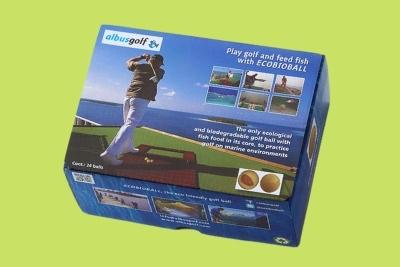
Why I Recommend It: The AlbusGolf EcoBioball biodegradable balls (certified by the OECD) will fully degrade in around 48hrs, leaving nothing behind but fish food.
Personal Experience: The EcoBioball is the most marine-friendly golf ball I have found. EcoBioball balls are safe to hit into rivers, lakes, or oceans. They dissolve within 48 hours and actually contain fish food, so they help wildlife rather than harming it.
The golf courses I usually play in the Florida area have A LOT of water hazards, which unfortunately I am all too familiar with! So it was important to find a ball that was gentle in marine environments. This is the perfect guilt-free solution.
One word of caution: treat these as practice balls, not for shooting an 18-hole round. In my experience, they don’t fly as far as traditional golf balls (I was able to achieve between 70 and 80% of the usual distance with long irons, a little less with the driver).
I love using them when playing with friends, family, or business associates because they’re very much ‘on message’ for TheRoundup and always a talking point.
Even if you don't lose the ball during your round, I advise tossing it into the lake/ocean before hitting the 19th for a well-earned beer (especially if the course was damp). These balls are not designed to play multiple rounds over multiple weeks.
Hitting balls off a boat or the beach into a lake or ocean is great fun, and with the Ecobioball, you can now do it with a clear conscience. They are more expensive, but you can save a few bucks and bulk-buy the 200 pack.
✔ Fully Water Soluble
✔ Non-Toxic
✔ Can be Customized with Your Name or Logo
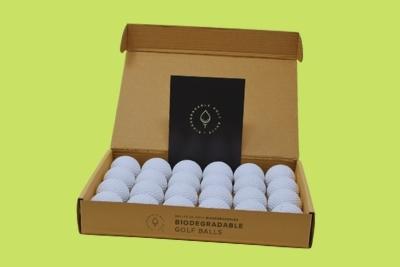
Why I Recommend It: With a brand name like "Biodegradable Golf Balls" you'd expect it tto do exactly what it says on the tin - and it does. They're great for single-use hitting into water, or playing courses with a lot of water hazards.
Personal Experience: Biodegradable Golf Balls degrade more slowly than Ecobioballs. It takes between 2 and 4 weeks, rather than 2 days.
This slower rate of degradation means that the balls last longer and can be used for multiple rounds of golf over a period of about a week. After that time, I noticed they started falling apart, and performance dropped off.
Speaking of performance, I found that I could get these Biodegradable Golf Balls to fly further than Ecobioballs, but still not as far as standard plastic and rubber balls.
If you’re playing a more serious round where your score counts, but you still don't want to sacrifice your eco-credentials, Biodegradable Golf Balls are probably a better option than Ecobioballs.
They come in plastic-free cardboard packaging, too.
✔ High Performance
✔ 100% Recyclable
✔ No Harsh Chemicals or Pollutants

Why I Recommend It: Dixon Wind is a solid compromise between sustainabiility and performance. These balls are not biodegradable, but they are recyclable and free from the worst toxic materials like heavy metals. They travel a lot further than the dissolvable balls, and are suitable for tournament use.
Personal Experience: These Dixon Wind balls flew the farthest of all the eco golf balls I tested!
They're ideal for players with a slower swing speed, and they perform so well that many players say they go even further than their regular big-brand synthetic balls.
When I tested them on the driving ranges, I found they go about the same distance as a synthetic ball. In fact, if you switched out my Titleist for a Dixon Wind and asked me to play blindfolded, I wouldn't be able to tell the difference.
The trade-off is that they don't dissolve, so if you lose them in water, that's where they'll stay. However, at least they're less toxic than regular balls, so you feel a little less guilt.
The real difference is the balls you don't lose (or those that can be found again), as these can be recycled.
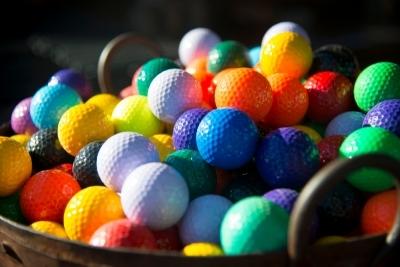
Why I Recommend It: These are lost balls that have been recovered from lakes and hazards on 2000 golf courses around the country. They are then cleaned, reconditioned in a factory, quality checked, rated, and resold. Buying these means no new balls are produced.
Personal Experience: Ok. So these recycled golf balls are not biodegradable. But I've decided to include them because they’re quality recycled balls at an excellent price.
If you’re looking for colored balls but don't want to buy new ones and add to the U.S. golf ball waste problem, you can't go wrong with these balls at just 50¢ each.
The batch I got sent was of outstanding quality. A few of the balls were lightly scuffed, and around 15 had a company's logo stamped on them. But they all performed like new.
Not keen on colored balls? These Titleist Recycled Golf Balls are also of excellent quality and good value for money.
Biodegradable and traditional golf balls are made from different materials. That's why traditional balls harm the environment, and biodegradable ones don't.
Traditional golf balls are made from a synthetic rubber core wrapped in one or more layers and finished with a cover of either Surlyn (a hard ionomer resin) or urethane (a softer polymer used on premium balls for better feel and spin control).
Higher-end multi-layer balls may also include additional rubber or plastic mantle layers to fine-tune distance and spin. None of these materials is biodegradable, and they can take over 100 years to break down.
Biodegradable golf balls are most commonly made from polyvinyl alcohol (PVA), a water-soluble synthetic polymer, often blended with corn starch or other plant-based materials to control the rate of breakdown.
Some brands, like Albus Golf's Ecobioball, use proprietary biopolymers built around a fish food or coral core that doesn't harm marine life.
Yes, certified biodegradable golf balls are safe for fish and marine life because they are made from non-toxic, water-soluble materials that break down without releasing heavy metals or harmful chemicals.
Look for balls certified under the OECD 301B testing methodology, such as the Splash City Golf Zero® Ball (tested by RespirTek) and the Albus Golf Ecobioball, which goes a step further by using a fish-food core.
Conventional golf balls can leach zinc and other toxins as they degrade.
The main trade-off between biodegradable and conventional balls is in terms of performance.
No, biodegradable golf balls do not perform as well as traditional golf balls.
In my experience, the ball speed is lower. Biodegradable balls reduce your distance by around 30%
In independent robotic testing by Golf Laboratories, Inc., the best performing biodegradable ball (the Splash City Golf Zero®) carried 196.6 yards (179.8 m) off a driver at 95 MPH (153 km/h) club head speed, compared to roughly 250 to 270 yards (229 to 247 m) for a tour-level ball at the same swing speed.
They are designed for waterfront and recreational use, not tournament play.
Dixon Wind is the best option if performance is important, but it comes with an environmental compromise. Dixon Wind balls are sustainable and recyclable, but not biodegradable, so they don't offer quite the same environmental benefits.
Biodegradable golf balls prevent the long-term pollution caused by lost golf balls. Estimates suggest between 300 million and 1.5 billion balls are lost in the US alone each year, with up to 4 billion lost worldwide.
Biodegradable balls break down in days or weeks and do not harm the environment. Conventional golf balls take 100 to 1,000 years to decompose and release microplastics and heavy metals into the environment.
Here's what happens to traditional golf balls when they are hit into water or on land.
Hitting golf balls into the ocean is certainly a fun activity, but the answer depends on what type of ball you are using.
Traditional golf balls are made from materials such as rubber and plastic that do not biodegrade and can cause harm to marine life, so hitting them into the ocean is not recommended.
However, biodegradable golf balls, like ECOBIOBALL, are specifically designed to break down naturally without causing harm to the environment. So hitting these into the ocean is OK.
Always remember, though, that even if you have dissolvable golf balls, it is still important to follow local rules and regulations regarding golf course etiquette and environmental protection.
The exact time it takes to dissolve depends on the manufacturer, water temperature, and microbial levels.
When fully submerged, an Albus Golf Ecobioball can fully break down in as little as 48 hours, while others like Biodegradable Golf Balls take up to 4 weeks.
Yes, the Biodegradable Golf Balls brand sold on Amazon allows you to add your own name or logo, making them a popular choice for corporate events, weddings, charity tournaments, and giveaways.
Custom biodegradable balls are particularly well-suited to waterfront events where guests can hit branded balls into the ocean or a lake without environmental guilt.
No. However, the Plastic Pick-Up movement (started by Alex and her dad in 2016) has definitely sped up the development of environmentally friendly golf balls.
Golf in the U.S. is booming. Forbes reports that almost 25 million Americans play the game.
But those balls that end up in the water rather than in the hole cause a problem.
Switching to eco-friendly balls helps reduce the environmental impact and protect waterways and aquatic life.
Our core values mean we always prioritize sustainability over profit. We carefully research and evaluate every product to ensure they meet our high standards. All products featured in this article are recommended in accordance with our Review Methodology.
TheRoundup.org - As Seen On

