
TheRoundup is reader-supported. We may earn a commission when you make a purchase via links on this site, at no cost to you.
All products are reviewed in accordance with our Review Methodology.

Are you seeking the perfect organic bath towels to meet your sustainable lifestyle needs?
I understand how important it is to prioritize eco-friendliness without paying a premium or compromising on quality.
With that in mind, I've used my testing and research experience to comb through dozens of towel options to bring you this list of the best organic towels for 2026.
I'll also cover important topics such as why organic materials are better, what to prioritize when shopping for new towels, and laundry care.
But first, here are the best brands that produce affordable, luxury beach, hand, and bath towels without harming the planet...

✔ Super Absorbent
✔ Lovely Plush Feel
✔ Luxury Spa Quality
Why they're my Top Pick: Avocado bath towels are my personal favorite of all the certified organic cotton towels I tested.
It's a narrow victory, because I loved Boll & Branch and Delilah Home towels too. There's little to choose between the three brands. But I kept the Avocado towels to be my premium set to use at home, mainly because they feel closest to what I call "spa quality."
Personal Experience: Avocado towels scored top marks in my softness, absorbency, and durability tests. They feel incredible against the skin, and the heavy 700 GSM (grams per square meter) thickness absorbs water fast and effectively.
The fabric feels very substantial, and I'm convinced these towels will last a very long time. Even after 20 washes, they look and feel good as new. I've not seen any sign of pilling or loose threads. In fact, I noticed they seem to get even softer after the first 2-3 washes.
Avocado's plush bath towels are priced at the top end of the market. They sell individually rather than as complete sets, which is good if you only want to buy one or two. However, if you're looking for a full set, Delilah Home or Boll & Branch offer better value.
But Avocado offers a premium and indulgent experience that makes me feel like I'm taking a daily spa break. And the handy hanging loop on each towel makes it easy to dry them on a hook.
I also love that they're one of only a select handful of towels available in the US that are MADE SAFE® certified. This means they don't contain any ingredients known or suspected to harm human health, animals, aquatic life, or ecosystems.
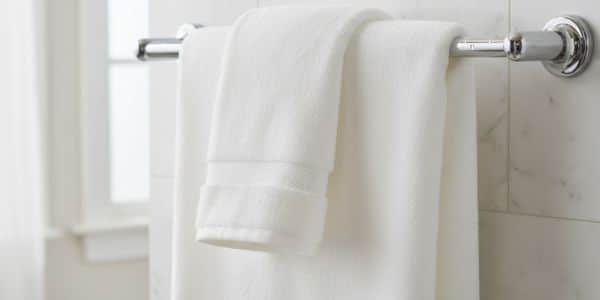
✔ OEKO-TEX Certified
✔ Luxury Soft Texture
✔ Very High Absorbency
Why it's Good for Sensitive Skin: People with sensitive skin need ultra-soft, absorbent towels that are free from harmful chemicals and dyes.
Boll & Branch towels are the perfect fit. They're incredibly plush, highly absorbent, and OEKO-TEX MADE IN GREEN certified. That means these towels have been independently tested for harmful chemicals, dyes, and finishes that can irritate sensitive skin.
Personal Experience: Boll & Branch offers a range of organic towel sets, including the cheaper (but still luxurious) Plush Bath Towel Set, which I tested. They also sell ribbed and waffle towels made from organic Turkish cotton, which are around 30% more expensive.
The Plush set I tested feels incredibly luxurious. If that's their budget product, I can only imagine how soft the Turkish cotton towels are!
In terms of softness, durability, and absorbency, Boll & Branch is on a par with Avocado's organic cotton towel range. There really is very little to choose between them.
Boll & Branch sells towels as sets or individually, and they work out cheaper than Avocado. Choose Boll & Branch if you're looking for a complete towel set or want comparable luxury at a medium price point.

✔ Ideal for Beach, Pool, or Gym
✔ Also Sells Luxury Bath Towels
✔ Great Value for Money
Why They're the Best Organic Beach Towels: Delilah Home's Sunset Beach Towels range is (as the name suggests) specifically designed for the beach. It has a sand-resistant design, which I find attracts less sand than regular beach towels, and is easy to shake off after use.
Sunset Beach Towels also work really well for the pool and gym because they're very absorbent but still lightweight and easy to carry. They roll up very tightly and fit easily into a beach bag. Thanks to a 400 GSM density, they're stronger and softer than any other beach towel I've ever used.
Why They're the Best Affordable Organic Towels: Delilah Home organic bath towels, bath sheets, and hand towels are very close in quality to Avocado and Boll & Branch, but cost much less.
Although they're sold in packs of 2, the cost per towel works out at less than half that of Avocado. They're even cheaper if you use our TRU15 discount code! I think this represents the best value for money on the market right now.
Personal Experience: My wife and I both loved using Delilah Home's Turkish bath towels. They weigh in at 700 GSM and feel just as thick and soft as the Boll & Branch plush towel set. I noticed they get 5* feedback from over 400 customer reviews, so we're not the only ones who love them.
As a regular beachgoer, I especially love the Sunset towels, and I use them all the time. I'm amazed at how light they are to carry, considering the quality. They're easily the best I've ever used and are now my first choice for trips to the seaside, pool, or gym.
Delilah Home also makes organic kitchen towels, which most of the other brands listed don't. Useful if you plan on upgrading to GOTS-certified organic cotton in every room of the house!
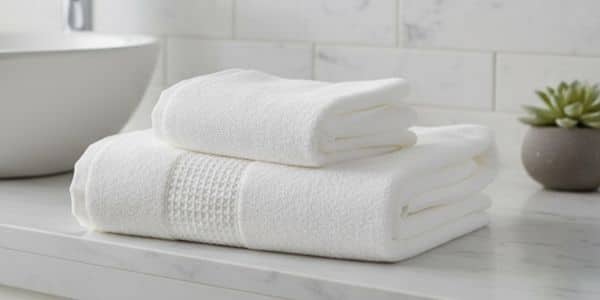

✔ Selection of Weaves & Styles
✔ Thin, Lightweight Ranges
✔ 15% Discount (ROUNDUP15)
Why They're the Best Quick-Drying Organic Towels: Coyuchi Adriatic and Air Weight organic ranges are both thinner and lighter than the other bath towels and sheets I'm recommending. The Adriatic range, in particular, dries very quickly even indoors.
Personal Experience: Coyuchi sells a range of different towel designs, so we decided to try them all. Here are my thoughts on each range.
Coyuchi is priced as a premium product, similar to Avocado and more expensive than Boll & Branch and Delilah. However, we did manage to negotiate a discount (see below) that brings the price in line with comparable brands.
Coyuhci also makes Baby Towels, which we felt were of very good quality. However, our next pick Quince got the nod because of its more parent-friendly, affordable price point.
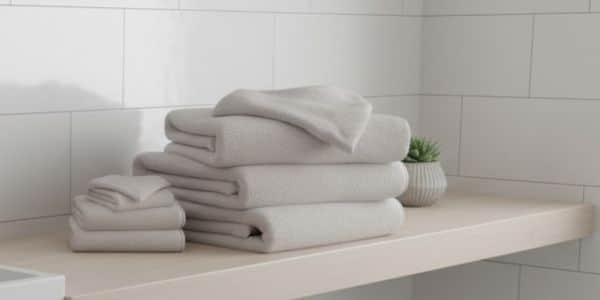
✔ Designed for Kids Aged 1-6
✔ Great Value
✔ 5* Customer Reviews
Why They're Best for Kids: The Quince kids' towel bundle includes 4 x hooded towels and 4 x washcloths, all for under $100. For parents on a budget who still want to keep synthetic fabrics away from their kids, this represents great value for money.
Personal Experience: I asked my sister in law to help test these towels after my nephew Alfie's notoriously "splashy" bathtimes. She was really impressed with the softness and the fact that they hold up well after multiple washes without any loose threads.
Hooded towels are great for toddlers because the hood helps keep their head and neck warm and stops them from getting chilly when they get out of a warm bath. Softness is equally important because it helps prevent friction against sensitive skin. So I was pleased to hear that the Quince Towles offer both.
It's worth noting that although the product is organic according to the brand, it's not independently certified. However, this is a trustworthy brand based in San Francisco that I already know from previous reviews. For that reason, I am happy to take their word for it in terms of the authenticity of the fibers.
Thanks to Quince's direct-to-consumer model, the price is very affordable. I feel this is a great deal in terms of price and quality that will appeal to eco-conscious parents.
The brands I've listed above stood out to me as the best of the best. I rejected more than 15 brands that didn't meet my criteria (see below). But others came very close and deserve a mention.
So those are my selections. Next, a word on how we tested and what the ratings mean.
My family and I tested each of the brands listed above (and a further 15+ we decided not to recommend) in real, everyday family life for a period of at least four weeks each. During the test period, we also washed each product at least 10 times.
We only considered towels made from 100% organic materials and gave priority to those that have third-party certification.
After use, we assigned each product a proprietary score (1-5) for softness, absorbency, and durability. The criteria for these were as follows.
Softness Score:
Absorbency Score:
Durability Score:
All products were purchased online using the links provided above. No brand is permitted to pay for inclusion or position in our lists. Our evaluations are based solely on genuine first-hand experience combined with prior industry knowledge.

Organic towels are better for the environment and may also have health benefits compared to both regular cotton and synthetic microfiber alternatives.
Organic cotton benefits the environment by using less water, avoiding synthetic pesticides, cutting greenhouse gas emissions, and preventing plastic microfiber pollution.
As well as being better for the environment, some other advantages of organic cotton include potential health benefits.
Organic cotton offers the following potential health benefits compared to synthetic fibers.
These benefits show why it's so important to make sure your towels are made from 100% organic materials. Here's a quick guide on what you need to look for.
Use the following checklist for buying organic towels.
Most eco-friendly towels are made from either organic cotton or bamboo.
Bamboo towels are either Lyocell, or a bamboo viscose/cotton blend (which is typically only between 40-60% bamboo). Some bamboo towels are genuinely sustainable, while others may be prone to greenwashing.
Here's an overview of organic cotton vs bamboo in terms of absorbency, softness, durability, and environmental impact.
| Criterion | Organic cotton towels | Bamboo lyocell towels | Bamboo viscose cotton blend towels |
|---|---|---|---|
| What the fiber actually is | Natural seed-hair cellulose from cotton plants. | Regenerated cellulose made by dissolving wood or bamboo pulp in N-methylmorpholine N-oxide, then extruding and regenerating the cellulose. | Regenerated cellulose made by the viscose process blended with between 40-60% cotton. The viscose portion is usually rayon. |
| Labeling and claims | Can be labeled organic when certified. Look for GOTS on finished goods. | Must be labeled “lyocell.” If bamboo is the source, labels should not suggest it is natural bamboo fiber (FTC). | Must be labeled “rayon” or “viscose” with the blend percentage. FTC warns against implying bamboo-plant antimicrobial properties. |
| Absorbency | High absorbency typical of cotton toweling. Performance varies by yarn weight and loop density. | High moisture uptake is a known property of lyocell (Lenzing). | Viscose is hydrophilic. Blended towel absorbency depends on the viscose ratio and construction. |
| Softness and feel | Soft and familiar terry hand that improves with wash and finish. | Smooth, cool hand with a sleek drape typical of lyocell. | Viscose contributes a silky feel while cotton adds body. Exact feel depends on blend and loops. |
| Durability when wet | Cotton strength holds up well in wet use and repeated washing (Science Direct). | Lyocell maintains good wet strength compared with viscose (Science Direct) | Viscose loses strength when wet, which is why it is frequently blended with cotton in towels. |
| Typical care | Routine machine washing is common. Follow label for heat and finish. | Follow label. Gentle cycles help preserve surface appearance. | Follow label. Avoid harsh agitation and high heat because viscose weakens when wet. |
| Environmental process notes | Organic systems restrict most synthetic pesticides and fertilizers. GOTS adds process chemical rules and wastewater criteria. Impact still depends on farm region and mill practices. | Lyocell is made in a solvent system that, in best-practice mills, recovers and reuses essentially all solvent. Lenzing reports more than 99.8 percent recovery (Lenzing). | The viscose process uses carbon disulfide. Regulators describe emissions controls and BAT levels. Impacts vary widely by mill and controls (CDC). |
| Common pitfalls to check | Verify live GOTS certificate and product category. | Watch out for “Bamboo” language that obscures lyocell content or overstates benefits. | “Bamboo” marketing on viscose without accurate fiber naming, or unsubstantiated antimicrobial claims. |
In summary, here's what material you should choose.
When you choose products certified by respected organizations, you make a positive impact while avoiding greenwashing.
But what does GOTS certified mean for towels, and how do MADE SAFE and OEKO-TEX apply? Here's a list of the relevant sustainability credentials and how they apply.
Look for companies committed to fair trade and sustainable production methods. The certifications above (especially Fair Trade) are a good indicator.
Ethical production means paying workers fairly, providing safe working environments, and making sure there is no child labor at any point in the supply chain.
Towel weight is measured in GSM (grams per square meter), which is an indicator of weight and density.
When buying sustainable towels, choose a GOTS-certified option first, then pick a GSM that fits your drying setup and feel preference.
This comes down to personal preference.
Some people prefer the plush feel of a thick towel, while others like the lightweight softness of a thinner one.
The brands I've recommended above sell towels either individually or in sets. When making your purchase, make sure you get the correct size towels for your needs.
Once you've chosen your towels, here are some tips to help you care for them.
Keeping your certified organic bath towels fresh and fluffy while being eco-friendly is a breeze if you follow these simple pointers.
Washing your towels after every use is unnecessary.
You can typically use a towel 3-4 times before it needs to be washed.
When it's time to wash, use cold water settings on your washing machine. Not only does this conserve energy, but it also helps your towels retain their color.
Also, try to fill up your washing machine to its full capacity to maximize water efficiency.
When washing your towels, less is more! Overusing detergent can lead to a buildup of residue, which reduces the absorbency of your towels.
Choose eco-friendly detergents free from harsh chemicals to keep your towels soft and kind to your skin.
Steer clear of fabric softeners. Yes, you heard that right. While they might make your towels feel soft, they coat the fibers and reduce their absorbency.
Instead, you can use white vinegar, which naturally softens your towels and removes any lingering odors.
Drying your towels properly is crucial for their longevity.
If possible, line-dry your towels outside. The sun's UV rays have natural sanitizing properties, and the breeze leaves your towels beautifully fresh. Plus, you'll be saving energy by skipping the dryer!
If you need to use a dryer, opt for a lower heat setting to prevent your towels from shrinking or losing their softness.
And remember, don't over-dry your towels, as it can make them stiff and brittle.
Once your towels are completely dry, fold them neatly and store them in a cool, dry place.
Avoid piling too many towels together, which can trap moisture and lead to mildew.
Yes, for most households, they are worth the cost.
Premium organic towels cost $32-70 compared to $20-25 for conventional options. But they last 2-3x longer (5-7 years if you follow the care instructions above vs 18-24 months). That makes the annual cost lower for organic options over the lifespan of the product.
Choose the premium set when you will care for them and can dry them fully between uses.
Towels made from organic cotton offer further measurable benefits. They produce 46% fewer greenhouse gas emissions, use 14% less water, release zero microplastics, and are GOTS-certified to limit formaldehyde exposure.
For people with sensitive skin or eczema, dermatologists specifically recommend 100% organic cotton towels to avoid chemical irritants.
If budget is a concern, start with affordable certified options like Delilah Home at $32.50 per towel (use code RU15 for 15% off). You get the same benefits as premium brands at half the price.
Yes, Turkish cotton is highly regarded for its softness and absorbency. It's an excellent choice for the best organic bath towels (and also bath mats, face towels, robes, etc.), offering both luxurious comfort and superior absorbency.
Yes, Egyptian cotton is considered one of the world's finest fibers and is renowned for its softness and absorbency. It is also highly durable, making it a good choice for towels (although it's much more commonly seen in organic bedding).
Bath towels should generally be replaced every two to five years, depending on usage and washing. Don't just toss your old towels in the trash; donate them to a worthy cause.
Microfiber is not a sustainable choice. As covered in my is microfiber toxic article, one of the major concerns with microfiber is the amount of microplastics that enter our waterways after each wash.
Generally speaking, two to four towels per person is a good rule of thumb for most households, but it depends on the size of your family.
To stop towels from shedding fluff, it's essential to use a mild detergent and gentle cycle when washing them. Also, avoid using fabric softeners, as they can coat the towel's fibers and make it more likely to shed. Finally, follow the care instructions on your towels for the best results.
Organic bath towels are crafted with a focus on sustainability, ensuring they're made from environmentally friendly materials and produced using methods that minimize harm to the planet.
If you need more ideas after replacing your towels, check out our guide to creating an eco-friendly bathroom for more sustainable swaps.
Do you prefer a plush towel? Or is lightweight more your thing? Have you already made the switch to eco-friendly bath towels? Or are you happy using conventional cotton towels? Drop me a line and let me know.
Our core values mean we always prioritize sustainability over profit. We carefully research and evaluate every product to ensure they meet our high standards. All products featured in this article are recommended in accordance with our Review Methodology.
TheRoundup.org - As Seen On

