
TheRoundup is reader-supported. We may earn a commission when you make a purchase via links on this site, at no cost to you.
All products are reviewed in accordance with our Review Methodology.

Whether you're just refreshing the wall in one room or doing a complete home renovation, you want a paint that looks great while protecting your health.
Eco-friendly paints eliminate or drastically reduce volatile organic compounds (VOCs) - toxic chemicals that off-gas into your indoor air for years after painting. That's because Zero-VOC paints use water-based formulations instead of chemical solvents.
Modern Zero-VOC paint brands deliver excellent coverage and vivid colors that more than match up to mainstream options. In our testing, brands like ECOS and Benjamin Moore's Eco Spec performed identically to conventional paints for durability and color saturation.
Non-toxic paints typically cost 15-30% more than conventional paints, but the health benefits and improved indoor air quality justify the investment for most homeowners.
Read on to find out which brands came top of our tests.

✔ Families with Children or Pets
✔ Color Matching
✔ Made in USA
Why It's the Best Overall: ECOS markets all its paints, primers, stains, varnishes, and specialty coatings as zero-VOC (CDPH 01350) and non-toxic (ASTM D-4236). It's the only paint brand I tested that's 100% zero-VOC across its entire range.
ECOS Paints has third-party verification for VOC levels, and one gallon covers more than any other brand I've recommended. The next best coverage is Benjamin Moore at 400-450 sq. ft. per gallon.
ECOS Paints is trusted by institutions such as the Louvre, Westminster Abbey, the Getty Museum, and Google.
Why It's Recommended for Nurseries & Kids' Rooms: ECOS Lullaby paint holds EN-71 toy-safe certification for surfaces that children might chew.
ECOS paints contain no added algicides, mildewcides, pesticides, herbicides, or fungicides, and the water-based formula has no polyurethane odor. The brand publishes detailed ingredient lists for its paints, primers, stains, and varnishes, so parents can see exactly what's in the products they use.
Personal Experience: We tested ECOS interior wall paint in a semi-gloss finish in an enclosed room. Despite limited ventilation, there was no paint smell whatsoever during painting or after it had dried.
ECOS paint is thicker than the Benjamin Moore paint we previously used. Despite the thickness, it applies very smoothly with both a brush and a roller, and doesn't drip.
After painting with ECOS, the brush or roller cleans up easily with just hot water.
ECOS Paints match colors from other brands at no extra charge. Orders ship from South Carolina within two business days, and shipping is free on orders over $200.

✔ Commercial Facilities
✔ Kitchens & Bathrooms
✔ Made in USA
Why It's the Best for Kitchens, Bathrooms, and Other High-Humidity Areas: Benjamin Moore Aura Bath & Spa has three properties that work well in humid spaces such as bathrooms and kitchens.
- The formula contains mildew inhibitors.
- The washable matte finish remained intact through multiple scrubbings without color transfer to my rags.
- Aura Bath & Spa is a zero-VOC, low-odor paint, which is important in enclosed spaces with poor ventilation.
Why It's the Best Choice for Professional Painters: An old college friend of mine is a professional painter. He says he mainly uses Benjamin Moore Eco Spec or Ultra Spec 500 because the low odor disappears within an hour of application.
Benjamin Moore's Gennex system uses zero-VOC colorants that match colors consistently across batches. My friend likes this because he says it helps prevent costly callbacks due to color mismatches.
Personal Experience: I tested Benjamin Moore Eco Spec Semi-Gloss on old cabinets, trim, doors, and general woodwork given to me by a neighbor who had a new kitchen fitted.
The Benjamin Moore paint protected all my test pieces from damage once fully cured. I cleaned the test panels multiple times over two weeks and saw no significant deterioration in the finish.
I also tested Benjamin Moore Scuff-X at the same time, using the same criteria, and it performed even better than Eco Spec. However, Scuff-X is low-VOC and not zero-VOC, so it does not meet the requirements for this article. But if the very best durability is your priority and you're happy with low VOC levels, rather than zero, Scuff-X is also worth considering.
✔ Cracked or Distressed Finishes
✔ Suitable for Children's Furniture
✔ Made in USA
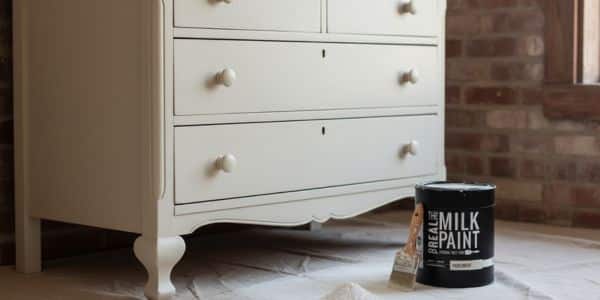
Why It's the Best for DIY & Upcycling Projects: Real Milk Paint Co. paint powder is well-suited to DIY projects because you can experiment with different color mixes before starting work.
I often use this milk paint powder to paint directly onto raw wood or yard-sale finds. I love how I can easily distress the natural matte finish of this milk paint to create a cool farmhouse look.
Mixed batches of milk paint powder stay good in my garage fridge for around two weeks between project sessions. This is perfect for amateur DIY enthusiasts like me who start and stop projects all the time.
Personal Experience: I helped my nephew Alfie paint his old crib when he moved into his big boy bed. He wanted to keep the crib for all his stuffed animals to sleep in. We used powdered paint from The Real Milk Paint Company because it is CPSC-compliant and marketed as kid-safe.
I lightly sanded the old crib, and then we mixed four pots of different colors to create a rainbow effect on the rails. The paint stuck really well to the sanded surface, and Alfie loved helping add more and more color.
The Real Milk Paint Company paint flows much thinner than conventional latex (it is more like stained water than standard paint). We needed three coats on most sections to get uniform coverage, and our first coat looked streaky until we added the second layer.
I sealed everything with Pure Tung Oil because unsealed milk paint feels chalky and shows fingerprints easily. The oil has darkened the finish and created a durable surface that has held up well over six months of Alfie's daily play.
The Real Milk Paint Company also sells finishing creams that offer three levels of sheen (dead flat, low sheen, gloss). However, these do contain low levels of VOC, so I chose the zero-VOC tung oil instead.

✔ Free Collection (Home Depot)
✔ GREENGUARD Gold Certified
✔ Made in USA
Why It's the Best Value for Money: BEHR PREMIUM PLUS typically costs around 60% less than ECOS Paints and about 40-55% less than Benjamin Moore's comparable zero-VOC lines. This is an impressive price point for a paint that holds GREENGUARD Gold certification and provides decent coverage for typical residential applications.
ECOS Paints covers more wall per gallon, has better ingredient transparency, and is the best non-VOC paint brand I tested. However, if you're on a budget and still want certified paint in your home, BEHR is an excellent alternative.
Personal Experience: My parents are retired and have started renovating their entire ground floor to fill their days. They wanted zero-VOC, but couldn't justify spending $85+ per gallon on specialty brands.
I researched options for them and recommended BEHR PREMIUM PLUS ECOMIX. ECOMIX costs about $5 more per gallon than PREMIUM PLUS, but has USDA Certified Biobased certification (guaranteeing at least 20% plant-based ingredients).
I spent three weekends helping them paint their living room, kitchen, and dining room with ECOMIX in eggshell finish. I was impressed that BEHR's paint covered their old baby blue walls in two coats. I've used plenty of budget paints in the past that require at least three coats.
BEHR PREMIUM PLUS ECOMIX has been on my parents' walls for around nine months, and it still looks as good as new. My dad accidentally scraped the wall while moving a bookshelf last week, and the paint didn't chip or peel.
I tested each paint brand in this guide on real renovation projects in my home and for family members over the past year. My family and I applied these paints to walls, cabinets, trim, and furniture to fairly rate their performance under normal living conditions.
We assessed each brand on these factors.
We rejected several brands that claimed eco-friendly status but lacked legitimate certifications. We also eliminated paints with poor coverage, excessive drying issues, or premature wear during our testing period.
We purchased every paint in this guide with our own money. No brand gifted us products, and no company can pay for inclusion in our recommendations. Our assessments reflect only honest performance testing and real-world results.
Zero-VOC paint is a popular option for those looking for eco-friendly and non-toxic home products. However, whether or not it's better than other paints depends on various factors.
In conclusion, choosing paints that are low or zero-VOC can be a great choice for people who want to reduce their exposure to harmful toxic chemicals and protect the environment. However, they may not always be the best option for everyone, depending on their budget, color preferences, and desired level of coverage.
According to the Minnesota Department of Health, “Volatile Organic Compounds (VOCs) are a large group of chemicals that are found in many products we use to build and maintain our homes. Once these chemicals are in our homes, they are released or “off-gas” into the indoor air we breathe”.
Common VOCs to look out for, and try to avoid, include:
Toxic interior paints are a significant contributor to poor indoor air quality. They can continue to emit toxic air contaminants even after the new paint smell has disappeared.
Eco-friendly paints have low levels of VOC. Some are even 100% VOC free.
The term ‘sheen’ refers to the level of glossiness. Most paint manufacturers offer the following sheens (from least glossy to glossiest).
It is important to be aware that low-VOC paint typically has a shorter drying time than traditional paint.
VOCs slow down the drying process of traditional paints since they require time to evaporate from the paint film. In contrast, low VOC paints use water-based solvents that evaporate more quickly, resulting in a shorter drying time.
The shorter drying time of low-VOC paint can be both an advantage and a disadvantage.
On one hand, it allows painters to apply additional coats sooner and complete the painting project faster. On the other hand, the faster drying time can make it difficult to achieve a smooth finish without visible brush or roller marks.
To ensure your paint is low-VOC, the main certifications to look out for are:
This said, if a paint brand had no certifications, it doesn’t automatically mean it’s toxic and should be avoided.
Maintaining a certified status can be too expensive, especially for small eco-friendly businesses.
Treat certification as a guide, but don’t make it your only selection criterion.
The EPA estimates that when stripping old paint from internal walls, the VOC levels in your home can skyrocket to over 1,000 times that of outside.
Always wear a respirator and open doors/windows to allow paint fumes to escape.
Also, don't forget to cover over your flooring, carpets, or rugs. Use an old sheet or a curtain to catch any spills.
Most zero-VOC paints dry to the touch in 2-4 hours and are ready for a second coat in 4-6 hours. Zero-VOC paints typically dry faster than traditional paints because they use water-based solvents that evaporate quickly, rather than chemical solvents.
Yes, zero-VOC paints are ideal for nurseries and children's rooms. Brands like ECOS Lullaby are specifically formulated for baby rooms, with no toxic off-gassing and complete ingredient transparency.
Modern eco-friendly paints offer equivalent or better coverage to traditional paints. In our testing, premium zero-VOC brands like ECOS offered coverage that was 1.5 times better compared to conventional alternatives.
Look for Green Seal certification, GREENGUARD certification, or CERTIFIED asthma & allergy friendly marks. However, smaller artisan brands may produce excellent eco-friendly paints without formal certification due to cost constraints.
Yes, many eco-friendly paint brands offer exterior formulations. ECOS Paints, for example, provides both interior and exterior zero-VOC options with excellent weather resistance.
Our core values mean we always prioritize sustainability over profit. We carefully research and evaluate every product to ensure they meet our high standards. All products featured in this article are recommended in accordance with our Review Methodology.
TheRoundup.org - As Seen On

