TheRoundup is reader-supported. We may earn a commission when you make a purchase via links on this site, at no cost to you.
All products are reviewed in accordance with our Review Methodology.
Titanium cookware is often marketed as 'non-toxic' and 'medical-grade,' but those labels can be misleading if you don't know what the pan is actually made of.
Titanium cookware is safe when it is pure and uncoated. Titanium is considered a safe, low-reactivity food-contact surface because it resists corrosion and helps limit metal transfer.
Coated titanium cookware is also generally considered safe, but you need to take extra care to avoid overheating the coating and releasing fumes.
In this guide, I break down the four main types of titanium cookware, what (if anything) can transfer into food, which temperatures actually matter, and when titanium is a genuine material advantage rather than just marketing speak.
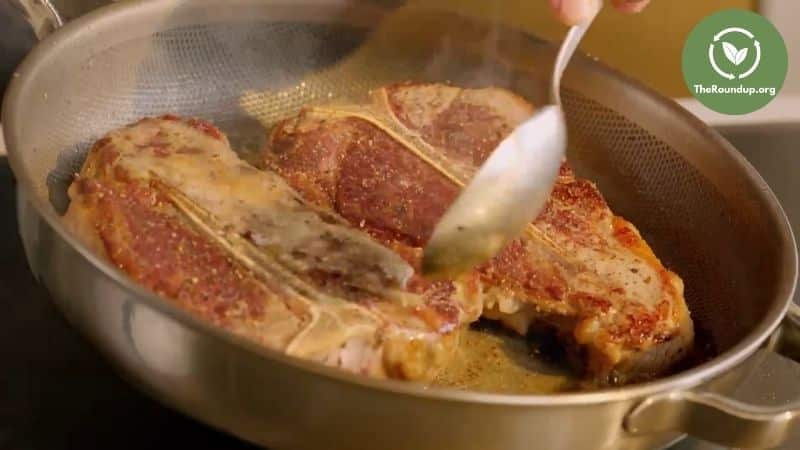
There are no documented health risks associated with uncoated titanium cookware when used as intended.
PTFE-coated titanium pans can pose health risks when overheated beyond approximately 360°C (680°F).
When a PTFE-based coating is overheated, it releases fumes. These fumes can cause short-term flu-like symptoms in some people (commonly called polymer fume fever or Teflon Flu) (Hamaya et al., 2015).
Titanium pots and pans with a food-contact surface of titanium metal are non-toxic and safe for everyday cooking.
Titanium in metals and alloys used for food contact is practically inert because it passivates (forms a protective oxide layer). That layer is hardly removed even by aggressive acidic salt conditions (The Council of Europe).
In simple terms, this means that titanium protects itself to some extent. When titanium is exposed to air, it quickly forms an extremely thin, invisible surface layer that acts like a shield. That protective layer prevents the metal underneath from reacting with food.
Titanium is biocompatible (used for implants and medical devices) and corrosion-resistant (Marin et al., 2023). This is another reason why titanium is considered to be non‑toxic.
Titanium cookware is commonly made from either solid titanium, another metal clad in titanium, or another metal with a nonstick coating (with added titanium) applied. See 'Types of Titanium Cookware and Their Safety' below for more details.
When you see titanium on the label, it does not always mean the whole pan is made from solid titanium. Check the manufacturer's description (or ask them further questions) to understand what you are actually buying and if it will release chemicals into your food.

Cookware with a pure titanium cooking surface is very unlikely to leach meaningful amounts of metal into food under normal cooking conditions.
When comparing aluminum, stainless steel, titanium‑coated stainless steel, and Teflon pots, a study shows very low titanium migration into a cooking solution of water and sodium bicarbonate. Titanium was among the least released metals, at around 0.009 parts per million (ppm) (Sianturi et al., 2020).
0.009 ppm of titanium migrating from cookware to cooking liquid is trace-level. In water-based liquids, ppm and mg/L are equivalent, so 0.009 ppm is about 0.009 mg per litre, which is 9 micrograms per litre. That means a 250 mL bowl of the cooking water would contain about 2 micrograms of titanium. This is a very small amount.
However, some pots and pans marketed as titanium do not have a pure titanium cooking surface. Sometimes manufacturers add titanium to a PTFE or ceramic coating. These coatings have the potential to leach chemicals under certain circumstances.
Polytetrafluoroethylene (PTFE) is found in titanium cookware coated with a 'Teflon-style' nonstick coating. See 'What Is PTFE Nonstick-Coated Titanium Cookware?' below for more details.
Perfluorooctanoic acid (PFOA) is a synthetic, highly persistent forever chemical belonging to the Per- and polyfluoroalkyl substances (PFAS) family.
PFOA is not present in newer US-made titanium cookware because it has been phased out under the PFOA Stewardship program. However, PFOA could still be present in some older or imported cookware products (U.S. EPA).
If you are unsure, see our guide to PFOA and PTFE Free Cookware for a list of brands that do not contain these substances.
The human health effects of titanium dioxide (TiO2) nanoparticles from cookware are not yet fully known.
Evidence is limited and inconclusive on whether titanium cookware releases titanium dioxide nanoparticles into food at levels meaningful under normal use (Golja et al., 2017).
The main health concerns with titanium dioxide are its use as a food additive (E171) and the possible cancer risk from inhaling large amounts of it as dust. (EFSA) (Baan, 2007).
These findings relate to food additive use and occupational inhalation exposures, not specifically cookware.
Titanium cookware is safe to use with tomatoes because it does not react readily to acidic foods.
For a full breakdown of each type, including construction and safety details, see 'Types of Titanium Cookware and Their Safety' below.
To get the full benefits of titanium, consider buying cookware with a titanium food-contact surface, not just a coating containing titanium.
The temperature limits for titanium cookware depend on what kind of pots and pans you have.
Next, let's break down the four common types of titanium cookware on the market so that you can match the guidance above to your own pans.
There are four types of titanium commonly sold in the US. They are solid uncoated titanium (often camping cookware), titanium-lined or titanium-clad cookware, PTFE titanium nonstick, and ceramic titanium nonstick.
Solid uncoated titanium cookware is made exclusively from titanium metal with no nonstick coating applied to the cooking surface. It's common in camping pots and ultralight cookware.
Solid titanium cookware does not distribute heat as evenly as heavier metals because titanium has low thermal conductivity (Encyclopaedia Britannica).
This type of cookware is safe because of the same protective oxide layer described above.
Titanium-clad/lined cookware is built in layers. The cooking surface (and sometimes the exterior) is made of titanium.
Other metals (such as aluminum and stainless steel) are used for the internal layers to improve heat performance and durability.
Titanium-clad/lined cookware is safe because the food contact material is titanium. This means you get the same inert properties and oxide-layer protection as with solid titanium cookware.
PTFE nonstick‑coated titanium cookware is usually either conventional PTFE-coated pans reinforced with titanium particles or, less commonly, a titanium base material coated with PTFE.
As discussed under 'Health Risks,' PTFE-coated cookware poses a risk only if overheated.
Other sources, such as the EPA and World Health Organization (WHO), raise concerns about 'forever chemicals' (such as PFAS in PTFE nonstick cookware) building up in people, animals, and the environment over time.
Exposure to certain PFAS may lead to adverse health outcomes. However, research is ongoing to determine how varying levels of exposure to different PFAS can lead to a range of health effects (EPA, WHO).
Many consumers remain concerned about potential exposure and look for non-toxic kitchenware and appliances, such as Teflon and PFAS-free air fryers.
If you want to be as safe as possible, I advise avoiding PTFE nonstick‑coated cookware until more is known about the effects of PFAS.
Ceramic nonstick-coated titanium cookware refers to pans with a base (often aluminum) topped by a sol-gel ceramic coating containing titanium particles or titanium dioxide for added hardness and durability.
Coated ceramic cookware is considered safe when it comes from a reputable manufacturer and is used as intended.
Ceramic nonstick-coated titanium cookware is PTFE-free, so it removes the potential issues associated with PFAS 'forever chemicals'.
Medical-grade titanium is not a standard for cookware. It's a term used in medicine to refer to specific titanium alloys that meet implant specifications.
When used in cookware marketing, medical-grade generally implies that the titanium is a high-purity grade or alloy also used in medical applications. But cookware itself is not regulated under medical device standards.
True medical-grade titanium, often referred to as Ti-6Al-4V ELI, meets specific ASTM standards for implants, such as ASTM F136 (ASTM International).
Anodizing deliberately thickens titanium's natural oxide layer, reinforcing the low-reactivity properties described earlier. This helps keep the surface low-reactivity in normal use.
Concerns about E171 refer to the use of titanium dioxide as a food additive. This is not the same exposure scenario as anodized titanium metal cookware (EFSA).
Undamaged titanium nitride-coated cookware is generally considered safe for normal cooking use.
Damage from daily use (scrubbing/scouring/scratching/etc) increases the migration of titanium (and silicon) into food for some nonstick/ceramic-style-coated pans (Addo Ntim et al., 2018).
The main documented concern with titanium nitride is inhalation at high concentrations (workplace exposure) and is not related to cookware. A study in rats has found lung effects at higher exposure levels (Kim et al., 2022)
The table below compares the four common titanium cookware options discussed in this article with common alternatives (stainless steel, nonstick, ceramic coated, and cast iron) across key attributes.
| Attribute | Solid Uncoated Titanium | Titanium-Clad / Titanium-Lined | PTFE Nonstick-Coated Titanium | Ceramic Nonstick-Coated Titanium | Stainless Steel | PTFE Nonstick (Standard) | Ceramic-Coated (Standard) | Cast Iron |
|---|---|---|---|---|---|---|---|---|
| Food Contact Surface | 100% titanium | Titanium surface over metal core | PTFE coating | Ceramic sol-gel coating | Stainless steel | PTFE coating | Ceramic sol-gel coating | Iron |
| Thermal Conductivity | Low | Depends on core (often aluminum for better heat spread) | Depends on base metal | Depends on base metal | Low (unless multi-clad) | Depends on base metal | Depends on base metal | Moderate heat retention, slow heat up time |
| Max Safe Temp | Tolerates extremely high heat | Limited by core metal | Avoid strong heating above ~360°C (BfR) | Usually 450-500°F (brand dependent) | High cooking temps tolerated | Avoid strong heating above ~360°C | Usually 450-500°F | Very high heat-tolerant |
| Overheating Risk | No coating to degrade | No coating to degrade | Polymer fume risk if overheated | Coating decomposition if overheated | Only if coated | Polymer fume risk if overheated | Coating decomposition possible | Only if coated |
| Acidic Foods | Safe (oxide layer resistant to acids) | Safe (titanium contact layer) | Safe if coating intact | Safe if coating intact | Can increase nickel/chromium leaching | Safe if coating intact | Safe if coating intact | Can increase iron transfer |
| Leaching Concern | Very unlikely under normal cooking | Depends on exposed rim/core | Coating breakdown is main concern | Coating breakdown is main concern | Nickel/chromium possible | Coating breakdown is main concern | Coating breakdown is main concern | Iron transfer possible |
| Nonstick Performance | Low-medium | Low-medium | High (when intact) | High (initially) | Low-medium | High (when intact) | High (initially) | Medium-high (when seasoned) |
| Durability | Very corrosion resistant | Very durable (bonding quality matters) | Coating wear limits lifespan | Coating wear limits lifespan | Very durable | Coating wear limits lifespan | Coating wear limits lifespan | Extremely durable |
| Weight | Very light | Moderate | Light-moderate | Light-moderate | Moderate-heavy | Light-moderate | Light-moderate | Heavy |
| Price Range | $30–$120 | $150–$400+ | $40–$150 | $40–$120 | $30–$200 | $15–$80 | $20–$80 | $20–$80 |
| Best For | Camping, ultralight travel | Serious home cooking | Everyday nonstick convenience | PFAS-free nonstick | Versatile daily cooking | Easy low-fat cooking | Health-conscious nonstick | Searing, slow cooking |
Titanium and stainless steel are both among the safest cookware materials for most people.
While stainless steel can leach small quantities of nickel and chromium, high-quality titanium leaches only trace amounts. Therefore, titanium is a better option for those with nickel allergies.
Once you know which style of cookware suits your needs, the next step is to choose a reputable titanium cookware brand.
Titanium cookware offers clear safety and durability advantages, but it comes with trade-offs depending on the type you choose.
The following table compares the benefits of titanium cookware to its drawbacks to help you decide whether it is the right choice for you.
| Pros | Cons | |
|---|---|---|
| Safety | Non-reactive; no documented health risks from pure titanium surface | PTFE-coated versions carry overheating risk; ceramic coatings degrade over time |
| Durability | Extremely corrosion-resistant; does not rust or pit | Nonstick coatings (PTFE/ceramic) wear out and limit pan lifespan |
| Weight | Lightest cookware metal (ideal for camping/travel) | Lightweight construction can feel insubstantial for stovetop use |
| Heat Performance | Can withstand very high temperatures (uncoated) | Poor thermal conductivity; uneven heating without an aluminum/steel core |
| Nonstick | Ceramic-coated versions offer PTFE-free nonstick | Pure titanium has low-medium nonstick performance, not as easy to clean as ceramic |
| Chemical Concerns | Pure titanium is PFAS-free, PFOA-free, and PTFE-free | Some "titanium" pans are standard PTFE nonstick with titanium marketing |
| Cost | Lifetime durability can offset a higher upfront price | Significantly more expensive than stainless steel or cast iron |
| Maintenance | Uncoated titanium is low-maintenance and dishwasher-safe (check brand) | Coated versions require careful handling to preserve the coating |
Solid uncoated titanium cookware does not work on an induction cooktop because titanium is not magnetic.
However, some titanium-clad and titanium-coated pans are induction compatible because they are built with a magnetic stainless steel base layer.
Here's how to check if your titanium pan works on induction hobs.
If you rely on induction cooking, confirm compatibility before buying. Do not assume that "titanium cookware" means "induction-ready."
Whether titanium cookware is worth it depends on what you prioritize. Use the framework below to match your needs to the right type.
Choose Solid Uncoated Titanium If...
Choose Titanium-Clad or Titanium-Lined If...
Choose PTFE Nonstick-Coated Titanium If...
Choose Ceramic Nonstick-Coated Titanium If...
Skip Titanium Cookware If...
To evaluate titanium cookware brands effectively, focus on the following criteria.
If you can't confirm these specs with the manufacturer or a trustworthy listing, treat the titanium claims as marketing buzzwords and move on to another brand.
To verify safety claims of titanium cookware brands, look for independent, checkable proof, not marketing language.
The following guidance helps you quickly get all the facts and decide whether the brand is right for you.
Based on my extensive testing experience, the best brands for quality titanium cookware are Taima Titanium and Our Place.
Read our Our Place Review to find more about this brand (they're also great for bakeware and air fryers).
If you choose cookware made from titanium, here are some tips on the best ways to clean and maintain it.
How you clean titanium cookware depends on whether the cooking surface is uncoated titanium or has a nonstick coating applied.
When it's time to replace your pans, learn how to recycle cookware and old pots and pans responsibly.