TheRoundup is reader-supported. We may earn a commission when you make a purchase via links on this site, at no cost to you.
All products are reviewed in accordance with our Review Methodology.
Is your partner a restless sleeper? Do their movements stop you from getting a restful night's sleep?
That's known as motion transfer, and it's relatively common. In a National Sleep Foundation poll (the 2012 Bedroom Poll), 24% of people said partner movement disturbs their sleep at least a few nights a week.
The best ways to reduce motion transfer are to add a mattress topper, fix or replace your bed frame, or buy a new mattress with motion isolation features.
Below, we answer all your questions on how to minimize motion transfer, which mattress types are best (and worst), and other steps you can take to get a better night's sleep.

Motion transfer refers to the transmission of kinetic energy across a mattress, allowing movement to propagate from one side of the bed to the other.
In other words, whenever your partner moves, you feel it, and your sleep is disturbed.
High motion transfer mainly arises from mattress and bed systems that are stiff, springy, and non-damping (i.e., they do not absorb force).
When a mattress lacks sufficient damping, energy from a partner’s movements propagates across the surface instead of being dissipated locally (Wellman et al., 1999).
Mattresses with interconnected innerspring coil systems are one of the most common causes of motion transfer.
Motion isolation is usually measured by either the "glass of water" test or the seismograph test. These work as follows.
If you feel that your mattress has poor motion isolation, there are some steps you can take to minimize the impact.
The most effective ways to prevent motion transfer are to replace your mattress, add a mattress topper, upgrade to a new bed frame, or fix your existing frame.
Changing your mattress is the most effective way to reduce motion transfer, but it's also the most expensive.
If your mattress is old, visibly sagging, or uses interconnected coils, it's probably the source of the problem, and no accessory will fully fix it.
See the "Best Mattress Types" section below for help in choosing the right mattress.
But you don't always need a new mattress to stop motion transfer. The issue may be a creaky frame or flimsy base, which could be solved by one of the cheaper fixes below.
A mattress topper helps minimize motion transfer as long as it is made from high-density materials such as natural latex or memory foam
Mattress toppers add an extra layer that absorbs movements and provides a buffer between you and your partner. They can even help solve the motion transfer problem on a spring mattress.
If you decide to buy a memory foam topper, make sure it is certified non-toxic to reduce your exposure to potentially harmful chemicals.
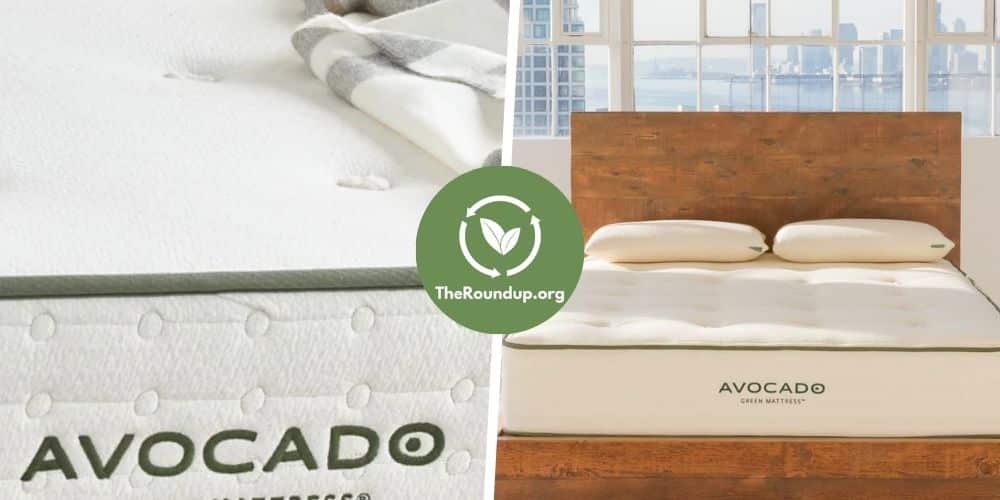
The Avocado Eco Organic mattress topper is one of the best at reducing motion transfer and has GreenGuard Gold and OEKO-TEX Standard 100 certifications (amongst many others). It's recommended in our guide to the best organic mattress toppers as the best option for couples.
Solid bed frames help reduce motion transfer by providing a stable, non-flexing foundation that prevents unnecessary movement or vibrations from amplifying.
Overall bed design, including pivot points and frame articulation, strongly influences how much a body moves relative to the bed and how forces propagate through the mattress and support system (Davis & Kotowski, 2015).
Wooden or metal platform frames with a slatted or solid base offer the best motion isolation capabilities. Our guide to sustainable bed frames has some excellent solid wood and metal options.
Wooden bed frames are often sturdier than metal ones. They don't require a box spring, and they minimize bounce and enhance overall mattress stability.
To stabilize a shaky bed, make sure you place the bed frame on a flat, level surface. Check for loose screws and joints, and that the frame is in a good overall state of repair.
Consider replacing the slats if they are warped or broken. Add plywood or a bunkie board under the mattress if it needs extra support.
For more DIY solutions for a shaky bed frame, see our guide on how to support a bed frame.
If DIY fixes do not have the desired effect, you may need to replace your mattress with one that offers superior motion isolation.
The best mattress materials for reducing motion transfer are solid organic latex, high-density memory foam, and natural hybrid mattresses with individually wrapped coils.
This diagram shows the best mattress types in terms of their ability to minimize motion transfer, and why.
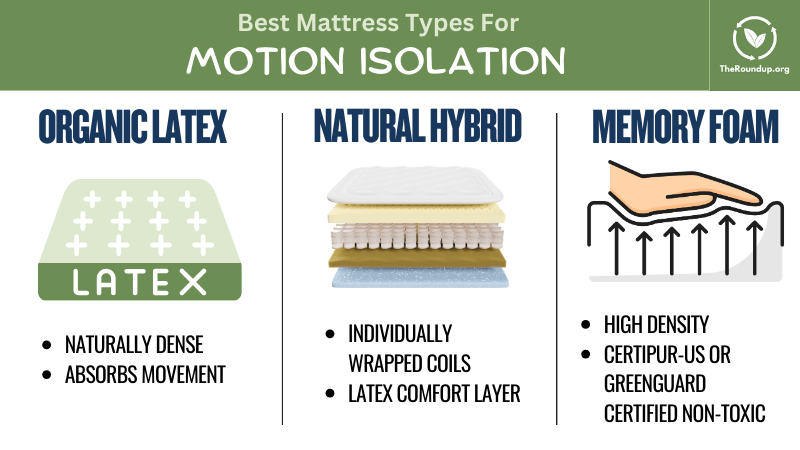
Traditional innerspring mattresses are usually the worst for motion transfer due to their system of interconnected springs (often referred to as Bonnell springs).
The following table summarizes the most common types of mattresses on sale in the US and their respective effectiveness at motion isolation.
| Mattress Type | Motion Isolation Rating | Key Features |
|---|---|---|
| Organic Latex | ⭐⭐⭐⭐⭐ | Absorbs motion at contact, highly responsive |
| Hybrid (Pocketed Coils) | ⭐⭐⭐⭐⭐ | Coils are individually wrapped to absorb movement |
| High-Density Memory Foam | ⭐⭐⭐⭐⭐ | Stable structure, contouring properties |
| Air Mattress | ⭐⭐ | Air shifts in response to movement |
| Low-Density Memory Foam | ⭐⭐ | Less effective absorption due to softer material |
| Innerspring | ⭐ | The least effective at isolating motion. Transfers movement due to connected coils |
Now, let's look at the more effective mattress types in more detail.
Effectiveness: ⭐⭐⭐⭐⭐
Organic latex is good for reducing motion transfer because it has a naturally dense and responsive structure.
It is equally as effective as memory foam, but it works differently. While memory foam absorbs the movement, latex bounces it back.
This ensures any vibrations on one side do not spread across the rest of the bed.
See our guide to latex mattresses to find out more.
Effectiveness: ⭐⭐⭐⭐⭐
If you choose a hybrid mattress, look for individually pocketed coils plus thick foam layers, and avoid very bouncy, continuous-coil designs to limit motion spread.
Individually wrapped coils operate independently rather than as a single, connected unit, so that when they compress, the movement is not transferred across the surface.
Most of the top eco-friendly mattress companies, such as PlushBeds, Avocado, and Naturepedic, include both these features on all their new hybrid mattresses.
Avoid brands with interconnected coils, as these do not offer effective motion isolation.
Effectiveness: ⭐⭐⭐⭐⭐
High-density memory foam mattresses help minimize motion transfer by absorbing movement rather than transferring it. Its effectiveness is on a par with that of natural hybrids with pocketed coils.
If you choose memory foam, it is important to make sure it is high-density and not low-density. Insist on a density of at least 4-5 lbs per cubic foot (PCF).
Tempur-Pedic motion isolation technology is an example of a dense memory foam that absorbs movement effectively, although it is not unique, and other manufacturers do an equally effective job.
However, there may be other downsides to memory foam, such as heat retention (Worsley / Baker, 2018), that may impact the sleep quality of one or both partners. There are also concerns regarding memory foam's potential toxicity.
If you buy memory foam, we recommend that it be certified non-toxic. Look for labels like CertiPUR-US® or GREENGUARD Gold to prove it doesn't contain any harmful chemicals.
The optimum setup for motion isolation is a split king latex or hybrid mattress with a solid wood bed frame.
A split King mattress is essentially two separate twin-sized mattresses pushed together. With this setup, motion from one side cannot transfer across to the other because the two sides aren't physically joined.
This setup works with any king-size bed frame.
Split-king mattresses are the best solution for couples of different weights. Because it is effectively two mattresses, it allows each partner to choose individual firmness for their side, according to their particular requirements.
A bed bridge doesn't have any effect on motion transfer, but it can be useful for people worried about separation in a split king bed.
The bed bridge fills the gap between two separate mattresses. So it solves the "crack in the middle" comfort problem for people who already have a split setup.
Bed bridges are available on Amazon for around $30.
Platform beds are generally superior to box springs for reducing movement, noise, and motion transfer because their solid or tightly-slatted construction provides a stable, non-springy base.
As mentioned above, a solid wooden bed frame with strong slats is the best way to enhance motion isolation.
Box springs tend to be lighter, noisier, and can add bounce. They are becoming less common in the US in 2026 as people tend to prefer box spring alternatives.
The best way to deal with motion transfer issues if you are on a budget is to try the cheapest solutions first. I recommend applying the options discussed above in the following order.
Working through the list in this order gives you the best chance of solving your problem without incurring the biggest expense, which is the cost of a new mattress.
The cost of a motion-isolating mattress varies depending on the size, type, and brand you choose. The following examples illustrate typical prices.
See our organic mattress price guide for a full breakdown and range of prices.
Persistent motion transfer can prevent one or both partners from getting a restful sleep.
Disturbed sleep may eventually lead to mental health issues and physical issues, including some chronic diseases.
Studies show that motion transferred laterally across a mattress is associated with a significant decrease in stage 3/4 sleep, which is the most restorative phase of non-REM (NREM) sleep (Wellman et al., 1999).
A deficiency of deep sleep (stages 3 and 4) may contribute to various health issues, including the following.
Your mattress plays an important role in avoiding sleep disturbances, but there are some other steps you can take as a couple to help improve your sleep.
Couples can improve their sleep quality by choosing bespoke solutions that suit their individual needs. Light sleepers, heavier couples, or couples of different weights should consider the following options.
Fixing a creaky or shaky bed frame is important for light sleepers, who are likely to be disturbed by noise as much as they are by movement.
Follow the DIY steps outlined above in the "Fix a Shaky Bed Frame" section. If these don't help, the best solution is a split king mattress.
Plus-size couples need both a bed frame and a mattress designed to support their body weight.
We recommend a low-profile solid wood bed frame such as the Thuma Essential Bed.
Pair this with the Saatva HD mattress, which supports bodies up to 500lb for the optimum combination.
The Saatva Solaire mattress is perfect for partners of different weights because it features adjustable firmness on both sides, with 50 settings to choose from.
It features a dual air chamber design that is designed to virtually eliminate motion transfer. We found this to be the most effective solution for couples of significantly different body weights when we tested it for our Best Organic Mattress roundup.
Sleeping in separate beds may not be the ideal solution for all couples, but it is certainly the most effective remedy for disturbed sleep.
In fact, 31% of Americans do sleep separately, according to a survey by the American Academy of Sleep Medicine.
If nothing else works, or if you don't have the budget to replace your main bed or mattress, then this is another option to try.
The best mattress for couples overall, according to our test results, is the PlushBeds Luxury Bliss.
It offers excellent motion isolation and strong edge support, so both partners can use the full width and length of the bed without causing the mattress to sag or risking rolling off.
It's also less than half the price of the Saatva Solaire.
Compare these and over 25 other top organic mattresses in our eco-friendly mattress guide.