TheRoundup is reader-supported. We may earn a commission when you make a purchase via links on this site, at no cost to you.
All products are reviewed in accordance with our Review Methodology.
GreenPan cookware is a popular choice if you want PFAS-free non-stick performance without the health concerns of traditional Teflon coatings.
Ceramic-coated nonstick pans now account for 35% of the global nonstick pan market (approximately 160 million units sold in 2024). GreenPan pioneered the technology in 2007 and remains one of its most recognised brands. But is it right for you?
I've been testing the GreenPan Valencia Pro 22-Piece Cookware Set since April 2025. My family and I use these pans for everyday cooking, from morning fried eggs to weeknight stir-fries. We like them overall, but the coating has limitations you need to know about.
In this GreenPan cookware review, I share everything we've discovered over months of testing, including the good, the bad, and the things GreenPan doesn't put on the box.
GreenPan is a good, safe choice for everyday non-stick cooking, with a PFAS-free ceramic coating and strong performance, but the coating has a limited lifespan that requires careful maintenance.
Let's start by taking a close look at the pros and cons we identified during our testing of GreenPan.

GreenPan cookware has strong non-stick performance, an attractive design, and PFAS-free materials. But the ceramic coating has a finite lifespan and requires careful handling.
GreenPan pans are worth the money if you prioritise PFAS-free cooking and easy cleanup, but the ceramic coating's limited lifespan affects long-term value.
I paid $599.99 for the Valencia Pro 22-Piece Set. That works out to roughly $27 per piece, which is reasonable for a premium set of this size. Saying that, though, ceramic-coated cookware needs replacing more frequently than stainless steel or cast iron, so the true cost over time is higher.
For comparison, the Caraway Cookware Set costs around $445 for 12 pieces (roughly $37 per piece), and Our Place's Always Pan Pro costs around $180 for a single pan. GreenPan sits competitively within the ceramic non-stick category, especially when you factor in the generous piece count.
The Valencia Pro has won recognition from America's Test Kitchen and Good Housekeeping for performance and sustainability. That's a good sign, but awards don't guarantee the coating will last.
If you're prepared to follow GreenPan's care instructions carefully and accept that you may need to replace pans every few years, the value proposition makes sense. If you want cookware that lasts a lifetime, stainless steel or titanium is a better investment.
The most common complaints about GreenPan cookware relate to coating durability, staining, and performance decline over time.
These issues are not unique to GreenPan. Most ceramic-coated non-stick cookware tends to have a shorter functional life than uncoated alternatives. The key is setting realistic expectations and following care instructions closely.
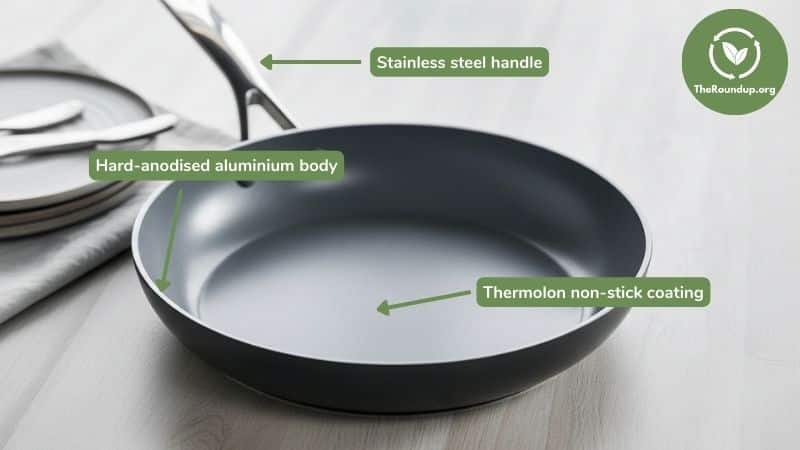
GreenPan cookware is made from aluminum or stainless steel bodies with a proprietary ceramic non-stick coating called Thermolon.
The Valencia Pro set I tested has hard-anodized aluminum bodies. The anodisation process makes the aluminum harder, more durable, and resistant to corrosion. GreenPan describes this as "DuoForged" construction, meaning the pans are pre-treated before being hard-anodized for extra strength.
The base of each pan includes GreenPan's Magneto technology, which uses ferromagnetic particles reinforced with copper. This makes the cookware compatible with induction hobs and improves heat retention.
The handles are stainless steel and riveted to the pan body.
GreenPan offers several different collections with varying constructions. The Valencia Pro, GP5, and Chatham lines use hard-anodized aluminum, while the Venice Pro line uses multi-ply stainless steel bodies. All collections share the same Thermolon ceramic non-stick cooking surface.
Thermolon is GreenPan's proprietary ceramic non-stick coating, made from silicon dioxide (a sand derivative) using a sol-gel process.
GreenPan introduced Thermolon in 2007 as an alternative to traditional PTFE (Teflon) coatings. The company states it was the first PFAS-free non-stick coating on the market.
The sol-gel manufacturing process creates a sprayable solution that is cured onto the pan surface. According to the American Chemical Society, ceramic non-stick coatings typically use this sol-gel method to combine mineral nanoparticles (such as silicon dioxide and titanium dioxide) into a gel structure. Manufacturers then add polymeric binders and adhesion agents before applying the coating to the metal base.
GreenPan does not publicly disclose the complete chemical formulation of Thermolon. They describe it in broad terms as "mineral-based" and made from "inorganic natural ingredients," but a detailed bill of materials is not available.
The Valencia Pro set features what GreenPan calls "diamond-infused" Thermolon, which the brand claims improves scratch resistance and heat responsiveness. Some collections also carry "Thermolon Infinity" or "Infinite8" branding, indicating newer generations of the coating.
It's worth noting that modern "ceramic" non-stick coatings are not traditional fired ceramic like a clay pot. They are thin sol-gel derived films applied to a metal base. This is standard across the ceramic non-stick category, not unique to GreenPan.
GreenPan cookware is non-toxic based on the third-party testing results the brand has made publicly available.
GreenPan markets its products as free of PFAS, PFOA, lead, and cadmium. The brand states it owns its own factory and controls its manufacturing process, which allows it to guarantee PFAS-free status.
GreenPan's Thermolon coating is NSF certified. NSF is an independent global health and safety organisation that tests products against rigorous food safety and toxicity standards. The certification confirms the coating is made with safe materials and does not leach harmful contaminants into food. GreenPan is the first and only ceramic non-stick brand to achieve this certification.
A publicly available SGS laboratory report (dated 2013) provides additional supporting evidence. The report shows "PASS" outcomes against several food-contact criteria, including EU ceramic lead and cadmium leaching limits, US FDA 21 CFR 175.300 extractives testing, and EU framework references. Specific migration tests for PFOA, formaldehyde, and primary aromatic amines all returned "not detected" results under the stated test conditions.
The report also tested for extractable heavy metals. Chromium, nickel, lead, cadmium, copper, cobalt, and manganese were all marked "not detected." Aluminum was reported at 0.27 mg/kg against a recommended limit of 2 mg/kg.
There are limitations to consider. The SGS report is dated 2013 and does not map explicitly to today's product lines. It also does not constitute a full formulation disclosure or a lifetime durability and migration assessment. "Not detected" means below the laboratory's reporting limits under specific test conditions, not absolute zero.
GreenPan claims compliance with major food-contact frameworks, including US FDA regulations and EU Regulation (EC) No 1935/2004.
There are no significant known health risks with Thermolon coating when used as directed, but some uncertainties remain about long-term nanoparticle exposure.
As covered in the previous section, Thermolon has passed third-party safety testing, including NSF certification. GreenPan recommends cooking on low to medium heat to maximise coating lifespan, though the brand claims Thermolon will not release harmful fumes even if accidentally overheated.
One area of ongoing research relates to nanoparticle content in sol-gel ceramic coatings. A study line presented in an EFSA-hosted presentation describes "quasi-ceramic" coatings releasing titanium (ions and particle fractions) into food simulants under sequential migration tests. This research is not specific to GreenPan, but it is relevant to the sol-gel ceramic non-stick category as a whole.
The long-term health implications of nanoparticle ingestion from cookware are not yet fully understood.
GreenPan cookware performs well for everyday family cooking, with even heat distribution and reliable non-stick release, though ceramic coatings have a finite lifespan.
The Valencia Pro set I've been testing since April 2025 heats up quickly and distributes heat evenly across the cooking surface. I've had no issues with hot spots when cooking omelets, sautéing vegetables, or simmering sauces.
Independent testing supports this. Prudent Reviews conducted instrumented induction hob tests comparing multiple cookware brands. The Valencia Pro showed a centre-to-edge temperature differential of just 33°F when heated to 400°F, compared to 124°F for Made In Non-Stick and 128°F for All-Clad HA1 in the same test. It also boiled 4 cups of water in 4 minutes and 45 seconds, the fastest in the non-stick subset.
| Cookware | Centre-to-Edge Temp Variance | Water Boil Time (4 cups) |
|---|---|---|
| GreenPan Valencia Pro | 33°F | 4:45 |
| Made In Non-Stick | 124°F | 5:02 |
| All-Clad HA1 | 128°F | 5:45 |
The same testing found Valencia Pro had zero warping after being heated to 425°F for two minutes. This matters for induction and ceramic hobs, where a warped base can cause uneven contact and reduce heating efficiency.
Heat retention is also strong. In Prudent Reviews' cooling test, GreenPan retained more heat after five minutes than several premium competitors, including All-Clad and Caraway.
GreenPan's non-stick surface typically lasts one to three years with heavy use, or longer with careful handling. The lifespan depends heavily on how you use and maintain the pans.
My grill pan's non-stick performance has declined after six months of use. Food no longer releases as easily as it did when new. The rest of the set still performs well, but I'm aware the coating degrades over time.
GreenPan's care instructions explicitly state that wear and reduced non-stick performance are normal. High heat, carbonised oil build-up, and dishwasher detergents all accelerate breakdown.
GreenPan's ceramic coating is more scratch-resistant than traditional nonstick cookware, but it is not scratch-proof. Careful handling is still required.
Some GreenPan collections, including Valencia Pro, are marketed as "diamond-infused" and "metal utensil safe." This means the coating tolerates occasional contact with metal better than some alternatives. It does not mean you can use metal whisks, sharp knives, or aggressive scouring without consequence.
GreenPan's care guidance recommends softer utensils to prolong coating life, and warns that sharp objects or cutting can damage the surface.
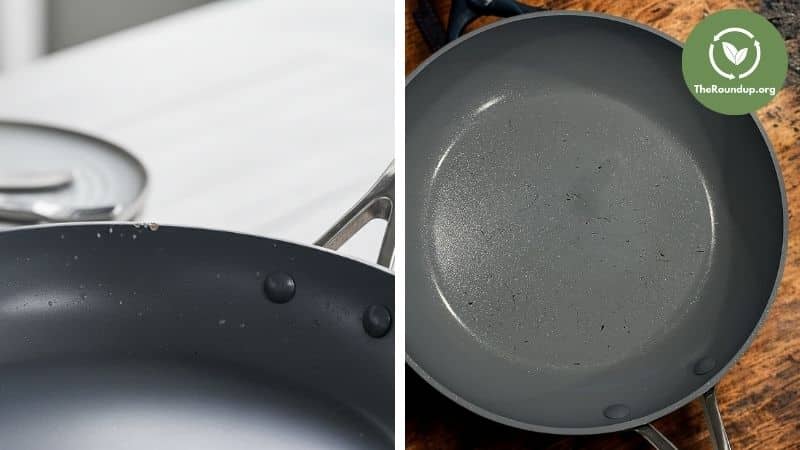
In my testing, I've used wooden and silicone utensils exclusively. The cooking surfaces on my pans show no visible scratches. I have noticed minor chipping around the edges of a couple of pieces, which is a known vulnerability for ceramic-coated cookware.
GreenPan is not ideal for high-heat searing. The ceramic coating performs best at low to medium temperatures.
If you want a hard sear on steak, burgers, or chicken thighs, ceramic nonstick cookware is the wrong tool for the job. The nonstick coating degrades faster at high heat, and the non-stick surface actually works against developing a good crust. Fond (the caramelised bits that stick to the pan) is essential for building flavour, and a slick non-stick surface prevents this from forming properly.
I used the Valencia Pro set for everyday cooking rather than high-heat searing. For steaks, I reach for my Taima Titanium pan.
GreenPan recommends low to medium heat for all cooking. While the brand claims Thermolon can withstand temperatures up to 450°C (850°F) without releasing fumes, sustained high heat will shorten the coating's functional life.
If searing is important to your cooking style, consider stainless steel, cast iron, carbon steel, or titanium cookware. These materials thrive at high temperatures and develop better crusts. I cover some of these alternatives in the comparison sections later in this article.
GreenPan cookware works on all stovetop types and is oven safe, though specifications vary by collection.
GreenPan cookware is oven safe, but the maximum temperature varies by collection.
The Valencia Pro set is oven- and broiler-safe up to 600°F (316°C). Glass lids are oven-safe up to 425°F (218°C).
Other GreenPan collections have different ratings. For example, the Spectra and Spectra Gold sets are oven-safe up to 850°F (454.4°C). Always check the product page for your specific set before putting it in the oven.
Frequent high-heat oven use accelerates coating degradation, even if the pan tolerates it structurally. For occasional use, this isn't a concern, but it is not something you should do regularly.
The stainless steel handles get hot in the oven. Always use oven gloves.
The Valencia Pro is an excellent choice for induction cooktops.
Its Magneto base uses ferromagnetic particles reinforced with copper, which makes the cookware fully induction compatible and improves heat distribution. In my testing, the Valencia Pro heated quickly and evenly on induction with no issues.
Not all GreenPan collections are induction compatible. All of its stainless steel collections work on induction, as does any collection with the Magneto base. Check the product page for your specific collection before buying.
GreenPan cookware should be hand-washed with mild soap, used on low to medium heat, and cleaned with soft sponges only. Avoid dishwashers, cooking sprays, and metal utensils to extend coating life.
The best way to clean GreenPan cookware is to handwash with warm water, mild soap, and a soft sponge.
GreenPan markets many products as dishwasher safe, but their care instructions recommend handwashing to maximise coating lifespan. Dishwasher detergents contain salts and bleaching agents that can accelerate coating breakdown over time.
Here are some tips to keep GreenPan ceramic nonstick pans in optimum condition.
Daily Cleaning (after each use):
What to Avoid:
Periodic Maintenance:
GreenPan recommends a light seasoning before first use and periodically thereafter to maintain optimal non-stick performance.
Apply a small amount of cooking oil to the surface and heat the pan on low for one to two minutes. Allow it to cool, then wipe out excess oil with a paper towel.
This isn't the same as seasoning cast iron, which builds up layers over time. With ceramic non-stick, you're simply conditioning the surface to help food release more easily.
Avoid cooking sprays. GreenPan's care guidance warns that aerosol sprays can leave a residue that builds up over time and affects non-stick performance.
GreenPan offers a limited lifetime warranty on manufacturer defects and a 2-year warranty on the Thermolon ceramic non-stick coating.
The lifetime warranty covers defects in materials and workmanship. It does not cover damage from misuse, overheating, or normal wear and tear.
The 2-year coating warranty is notably short compared to some competitors. It reflects the reality that ceramic coatings have a finite lifespan and will degrade with use.
| Brand | Coating Warranty | Defect Warranty |
|---|---|---|
| GreenPan | 2 years | Lifetime |
| Caraway | 1 year | Lifetime |
| HexClad | Lifetime | Lifetime |
| Our Place | 1 year | Lifetime |
Returns are accepted within 60 days for unused products in original packaging.
GreenPan was founded in 2007 and pioneered the first PFAS-free ceramic non-stick coating.
The brand is now one of the most recognised names in non-toxic cookware.
GreenPan is a reputable brand with a strong track record in ceramic non-stick cookware and bakeware.
The company was founded by Jan Helskens and Wim De Veirman and operates as part of The Cookware Company, which has headquarters in Belgium and production facilities in China, South Korea, Germany, and Italy.
GreenPan's Valencia Pro collection has won recognition from America's Test Kitchen and received Good Housekeeping's 2023 Sustainable Innovation Award. The brand's Thermolon coating is NSF certified, as covered earlier in this article.
GreenPan states it owns its manufacturing facility in Jiangmen, China, which allows it to control the production process and guarantee PFAS-free status. The factory holds ISO9001 certification.
GreenPan positions itself as an environmentally conscious kitchenware brand with several sustainability initiatives.
The company states that it uses solar power in production and has built an on-site wastewater treatment facility to treat and reuse water. GreenPan also claims the production of Thermolon generates 60% less carbon than traditional non-stick coatings.
The Valencia Pro collection uses certified recycled aluminum and has received Bronze certification from an independent assessment body for responsible manufacturing. GreenPan is also the first cookware company to achieve the Aluminum Stewardship Initiative (ASI) Performance Standard certification for responsible sourcing.
GreenPan's packaging is made from FSC-certified, sustainably sourced materials, and the brand offers a cookware recycling programme for old pans.
These are primarily self-reported claims. Independent verification is limited, but the ASI and NSF certifications provide some third-party assurance.
Yes, Bobby Flay has a partnership agreement with GreenPan under which he designed his own range.
Flay's Instagram feed shows him using the pans for dishes like scrambled eggs, shrimp, and searing - which proves he does genuinely use them.
In 2019, a class action was filed in California (Saldivar v. The Cookware Company LLC) alleging that GreenPan falsely advertised its products as "completely toxin free." The plaintiff claimed the Thermolon coating patent contained compounds classified as known toxins, including silane, aluminum oxide, and methyltrimethoxysilane. The lawsuit also challenged GreenPan's claims that its cookware was "reinforced with diamonds" and "good for the environment."
The case was dismissed with prejudice in 2020 through a settlement, meaning the same claims cannot be brought again. No court made a ruling on whether GreenPan's advertising was true or false. Since then, GreenPan has obtained NSF certification for its Thermolon coating and provides third-party SGS laboratory testing, both of which are covered earlier in this review.
GreenPan cookware sits in the mid to upper-mid price range for ceramic non-stick.
As mentioned earlier, the Valencia Pro 22-Piece Set costs around $600. Smaller sets and individual pieces are available at lower price points.
GreenPan products are widely available from Amazon.
They are also available at Target, Williams Sonoma, Macy's, Home Depot, Costco, and the GreenPan website.
Before deciding which pots and pans to buy, it's worth considering how GreenPan compares to its competitors.

GreenPan competes with other ceramic non-stick brands, hybrid cookware, traditional PTFE pans, and uncoated materials like stainless steel.
The following table gives an overview of how GreenPan compares to other cookware.
| Feature | GreenPan Valencia Pro | Caraway | HexClad | Stainless Steel (e.g. 360 Cookware) |
|---|---|---|---|---|
| Coating Type | Thermolon ceramic | Ceramic | TerraBond ceramic (hybrid) | None |
| PFAS-Free | ✓ Yes (NSF certified) | ✓ Yes | ✓ Yes (since 2024) | ✓ Yes (when uncoated) |
| Price/Piece | ~$27 | ~$37 | ~$58 | Varies |
| Coating Warranty | 2 years | 1 year | Lifetime | N/A |
| Dishwasher Safe | Yes (hand-wash recommended) | No | Yes | Yes |
| Induction Compatible | Yes (Magneto base) | Yes | Yes | Yes |
| Oven Safe To | 600°F | 550°F | 500°F | Varies (often 600°F+) |
| Best For | Everyday low-medium heat | Easy cleanup, aesthetics | Durability, high heat | Searing, lifetime use |
| Main Limitation | Coating degrades 1-3 years | Hand-wash only | Higher price, past PTFE concerns | Food sticks without technique |
| Where to Buy | Amazon | Caraway | Amazon | 360 Cookware |
Let's break down some of those comparisons in more detail.
I've tested both brands hands-on. Each has its pros and cons, but overall, I have a slight preference for Caraway.
My full findings are in our Caraway Cookware review, but here's a direct comparison.
Both are good options for health-conscious cooks. GreenPan edges ahead on durability and value. Caraway has a slight advantage in non-stick food release and aesthetics.
GreenPan and HexClad both make nonstick ceramic pans but using diffeernt technologies.
GreenPan suits cooks who prioritise PFAS-free credentials and value. HexClad suits those who want maximum durability and high-heat performance.
GreenPan's ceramic coating is a safer alternative to traditional PTFE-based non-stick cookware.
PTFE (commonly known as Teflon) belongs to the PFAS family of chemicals. When overheated, it can release fumes linked to health issues. GreenPan's Thermolon coating does not carry this risk.
PFAS regulations are tightening. Minnesota banned PFAS-coated cookware in January 2025, with other US states and the EU following.
PTFE coatings generally last longer than ceramic. If avoiding PFAS is your priority, non-toxic ceramic cookware is the better choice despite the shorter lifespan.
GreenPan and stainless steel serve different purposes in the kitchen.
Stainless steel has no coating, which means it can last a lifetime with proper care. It excels at high-heat searing and developing fond (the caramelised bits that stick to the pan and form the base of sauces). However, food sticks without proper technique, and stainless steel can leach nickel and chromium into acidic foods.
GreenPan's ceramic coating provides easy food release and does not leach metals. The trade-off is a shorter lifespan.
For everyday cooking where easy cleanup matters, GreenPan is practical. For high-heat searing and lifetime durability, stainless steel is better.
For more on stainless steel cookware, see our stainless steel safety guide.
GreenPan sells other cookware collections, including the Chatham and Padova Pro.
You can also buy individual fry pans (rather than as part of a collection), plus bakeware and electrical devices such as air fryers and ice cream makers.
| Feature | Valencia Pro | Chatham | Padova Pro | GP5 |
|---|---|---|---|---|
| Body Material | Hard-anodized aluminum | Hard-anodized aluminum | Hard-anodized aluminum | Hard-anodized aluminum |
| Coating | Diamond-infused Thermolon | Diamond-reinforced Thermolon | Diamond-infused Thermolon | Thermolon INFINITE8 |
| Induction Compatible | ✓ Yes (Magneto base) | ✗ No | ✓ Yes (Magneto base) | ✓ Yes (Magneto base) |
| Oven Safe To | 600°F | 450°F | 500°F | 600˚F |
| Handle Material | Stainless steel | Bakelite | Stainless steel | Stainless steel |
| Price Point | Premium | Budget | Mid-range | Premium |
| Best For | All cooktops, serious home cooks | Gas/electric stovetops, budget-conscious buyers | Induction users wanting value | New features / more durable coating |
| Where to Buy | Amazon | Amazon | Amazon | Amazon |
The Valencia Pro is GreenPan's flagship hard-anodized aluminum collection with a diamond-infused Thermolon coating, Magneto induction base, and stainless steel handles.
This is the collection I tested for this GreenPan review.
The Chatham is a more affordable hard-anodized aluminum collection with diamond-reinforced Thermolon coating. It is not induction compatible, so check your cooktop before buying.
The Padova Pro is a budget-friendly collection with hard-anodized aluminum bodies, diamond-infused Thermolon coating, and a Magneto induction base. It shares the same core features as the Valencia Pro at a lower price point.
The GP5 is GreenPan's new state-of-the-art collection featuring their latest technology, but at a higher price. It includes Infinite8 coating, which is diamond-infused for enhanced durability compared to standard ceramic non-stick.
The pans are 5mm thick (more than most like-for-like competitors) and still feature the same Magneto induction technology as the Valencia Pro and Padova Pro ranges.
The Valencia Pro 11-Piece Set offers a good balance of essential pieces for a family of four without overloading your kitchen cabinets.
For larger families or frequent entertainers, the 22-piece set provides more versatility.
Choose GreenPan if:
Choose a different material if:
The Valencia Pro is the collection I recommend. It works on all cooktops, heats evenly, and offers solid value for a 22-piece set.