
TheRoundup is reader-supported. We may earn a commission when you make a purchase via links on this site, at no cost to you.
All products are reviewed in accordance with our Review Methodology.

Non-toxic cribs are made from safe, sustainable materials, finished with low-VOC paints and stains, and independently certified for low chemical emissions.
Given that newborns spend 14 to 17 hours a day in their crib, buying safe nursery furniture matters more here than almost anywhere else in the house. Some traditional cribs can off-gas toxic chemicals just inches from your baby's lungs.
I spent 12 months testing and reviewing GREENGUARD Gold certified cribs that actually meet the chemical safety standards you need for your non-toxic home.
This guide is for parents who want a nursery free from off-gassing and avoidable chemical exposure, without spending hours decoding which certification label is real and which is marketing.
Cribs are classed as non-toxic if they are built from solid wood or steel, finished with coatings free from PFAS, lead, phthalates, and formaldehyde, and carry third-party certification confirming low VOC (Volatile Organic Compounds) emissions.
Five criteria separate genuinely safe cribs from the rest of the market.
Every crib that made my list below ticks all five of these boxes, so you can browse my top picks knowing the basics are covered.
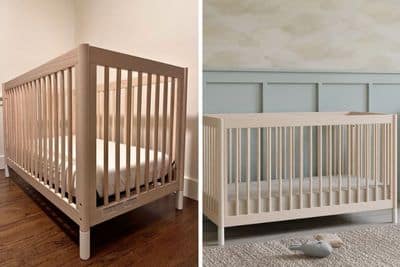
Why It's My Top Pick: The Gelato gets the nod as my overall winner because it strikes the perfect balance between modern design and being made with solid non-toxic materials.
It's made of solid New Zealand pine wood (and finished using a lead and phthalate-free non-toxic multi-step painting and staining process that exceeds the safety standards set by ASTM International). The Gelato crib comes with the prestigious GREENGUARD Gold certification, ensuring it's free from harmful chemicals.
Personal Experience: The low-profile design is perfect for peacefully putting a newborn to rest. It has four adjustable positions, so you can lower the mattress height as your baby learns to sit and stand.
The easy-to-use conversion kit that comes with this crib allows for a seamless transition as your little one grows, and I love the choice of rounded posts and customizable feet in vibrant colors to match any decor.
✔ Lasts into Toddler Years
✔ Highly Sustainable
✔ Super Easy Assembly
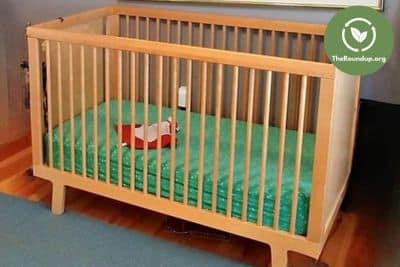
Why it's My Recommended FSC-Certified Option: This is one of the few affordable cribs with FSC Certification, for parents who want the peace of mind of knowing their crib was made in the most eco-friendly way possible.
Personal experience: The Sparrow crib by Oeuf impressed me due to its mix of eco-friendliness, durability, and style. Out of the box, I was really happy with its beautiful, modern look and sturdy construction that looks like it will last for many years.
From both an environmental and health perspective, the organic water-based finishes are perfect and give utmost peace of mind if you find your baby chewing on the crib rails during teething.
With a conversion kit, you can transform this crib into a toddler bed once your baby outgrows it. This means it's likely to be in use until they are 5-6 years old, at which point I expect it to be resellable due to the high-quality build.
I tested the assembly, adjustment between the three mattress heights, and conversion, and all were surprisingly simple. You can easily do this yourself without hiring a handyman.
This crib is expensive, but considering the sustainability, longevity, and resale potential, it is well worth the price.
✔ Fairytale Themed Bedrooms
✔ Ornate Detailing
✔ 3 Different Mattress Heights

Why It's the Best for Luxury: The Aurora from évolur has carved details that set this crib apart from flat-panel competitors I tested. The curved headboard, ribbon bow scrollwork, and Queen Anne feet give it a traditional, ornate look.
The solid poplar wood (with some fine veneers) construction of the Aurora makes it heavier than most other cribs I tested. I feel that this solid weight indicates a good build quality. With proper care, I can even see the Aurora being a crib that gets passed down through generations.
Personal Experience: I helped my neighbor select the évolur Aurora 5-in-1 crib after she asked for recommendations for a crib that combined ornate design with low emissions.
The évolur Aurora is GREENGUARD Gold certified, which means emissions were measured in a chamber and came in under UL's strictest limits.
Assembly of the évolur Aurora took just 45 minutes using basic hand tools, and it felt very sturdy once built. My neighbor's daughter has been using the crib for over 6 months, and she tells me it's still stable, with no wobble.
✔ Good for Travelling
✔ Easy to Move Between Rooms
✔ Fits in Small Spaces

Why It's the Best for Portability: The Delta Children Folding Portable Mini Crib folds to 6.5" in depth. It is very easy to store away in a small room or pack to take on vacation. The four casters mean you can move this crib easily between rooms. During testing, it fit through all my doorways without having to take the crib apart.
Personal Experience: Delta Children has earned its reputation through decades of family ownership and a founding principle that furniture should be "good enough for the founder's own child."
The crib I tested is made from New Zealand pine and TSCA-compliant engineered wood with GREENGUARD Gold certification.
The Delta Children Folding Portable Mini Baby Crib comes with a 1.5" mattress, which feels supportive enough for temporary use (such as a two-week vacation). However, if your child will be sleeping in this crib permanently, I recommend purchasing a higher-quality crib mattress.
A word of caution, though, if you do decide to swap out the mattress. The manual warns against adding an extra mattress and recommends only using the included mattress. Please follow the size limits (min 36 7/8" long, 22 3/8" wide, max 2" thick) and confirm compatibility of the new mattresses with Delta Children first.
✔ Tested for Chemical Emissions
✔ Non-Toxic Multi-Step Painting Process
✔ Made from Premium Steel
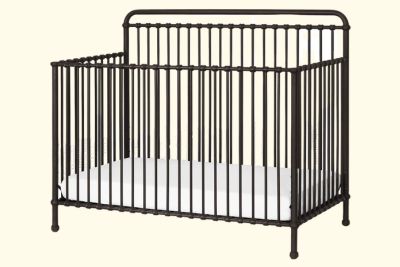
Why it's My Recommended Metal Crib: The coatings used in some metal frames contain heavy metals, like lead, which should be avoided for your baby's safety.
There are no such worries with the Winston 4-in-1 Convertible Metal Crib. Its painted finish was tested against UL's GREENGUARD Gold emission limits, the strictest tier UL certifies.
Personal Experience: I'm pleased to see four adjustable mattress positions, meaning this crib will easily accommodate your baby's growth. Start with the crib mattress at position one, then slowly drop it to position four over time as your baby grows.
Once your bundle of joy is too big for mattress position four, you can turn the crib into a toddler bed using this conversion kit.
I personally prefer the look and eco-credentials of wood cribs. But if you're looking for a non-toxic metal crib to add a vintage vibe to your nursery, this is the one for you!
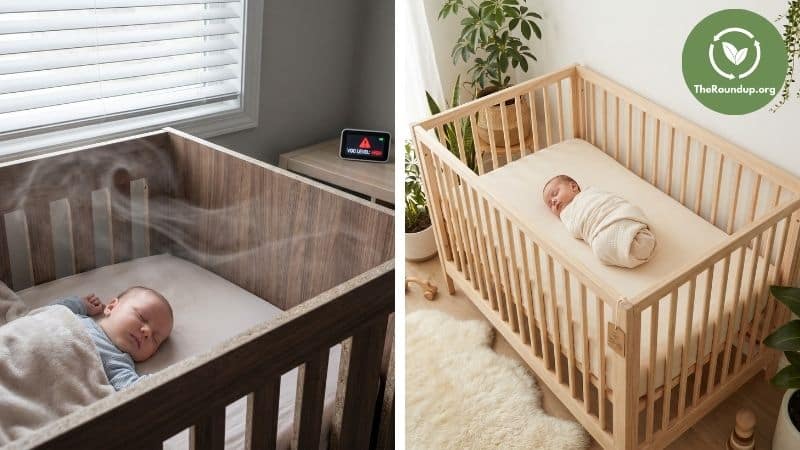
Non-toxic cribs matter because babies spend more time in their cribs than anywhere else in the house, and they have developing organ systems that are uniquely vulnerable to low-dose chemical exposure. The crib is the longest-duration source of contact a baby has with paint, stain, glue, and surface finishes during their first year of life.
The American Academy of Sleep Medicine recommends 14 to 17 hours of sleep a day for newborns and 12 to 16 hours for infants aged 4 to 12 months (Paruthi et al., 2016). During this time, a baby lies inches from whatever the crib is made of, painted with, or treated with.
Children are uniquely susceptible to environmental chemical exposures during early development, with adverse effects documented at doses well below those that affect adults (Grandjean & Landrigan, 2006). The same chemical load that would be acceptable in an adult bedroom is not automatically safe in a nursery.
The gap between what an adult body can shrug off and what a developing body cannot is the whole reason I treat the non-toxic question as the first filter on every crib I review.
The toxins most commonly found in conventional cribs are linked to four broad categories of harm in young children: respiratory damage, neurodevelopmental effects, endocrine disruption, and cancer risk.
Five chemical classes account for most of the documented concerns.
The good news is that all five hazards are avoidable by sticking to a small set of well-understood materials, which I'll cover next.
Solid wood and steel are the two safest materials for cribs, because neither releases VOCs like composite wood products do.
The following safe and/or natural materials are recommended.
Solid wood, steel, and TSCA-certified panels are the safest non-toxic furniture materials anywhere in the home. In a crib, the stain and the finish on top of them matter just as much, because they sit between the wood and your baby.
A wood stain colors the wood by soaking into it, while a wood finish forms a protective layer on top. Water-based versions of both are safer than solvent-based alternatives.
The following table compares wood stains and finishes.
| Wood stain | Wood finish | |
|---|---|---|
| Job | Adds color to bare wood | Seals and protects the surface |
| How it works | Soaks into the grain | Forms a clear film on top |
| Common types | Dye or pigment stains | Polyurethane, lacquer, shellac, hard-wax oil, natural oils (tung, linseed) |
| Higher-VOC option | Mineral-spirit and alcohol carriers | Solvent-based polyurethane and lacquer |
| Lower-VOC option | Water-based carriers | Water-based polyurethane, hard-wax oils, shellac, natural drying oils |
| Safer choice for cribs | Water-based | Water-based natural oil finish |
Look for stains and finishes explicitly free from PFAS, lead, phthalates, and formaldehyde. Higher indoor VOC levels have been linked to respiratory and asthma symptoms in children (Vardoulakis et al., 2020).
The fastest way to confirm a crib has been stained and finished safely is to check for the right certification on the finished product, which is the subject of the next section.
The single most important certification to look for when choosing a crib is GREENGUARD Gold. Here's a checklist of labels that verify crib safety and sustainability.
These non-toxic certifications apply to all types of cribs, and there are several varieties to choose from.
Non-toxic cribs come in five main types: standard, convertible, mini, portable, and bedside. Convertible models are popular because they last longer and offer better value for money.
You can buy non toxic cribs such as those I recommend above at Moderny Nursery, Oeuf, and Amazon.
Babyletto cribs are a good value for money option. The Gelato crib is my top pick because it lasts into your child's early years.
Beware of ultra-budget options because they generally don't carry important safety certifications such as those listed above.
No, not all cribs are non-toxic. Many cribs are made using paints, glues, and finishes that contain harmful chemicals, including benzene, formaldehyde, phenol, toluene, and 2-ethyl hexanoic acid.
These can be emitted into the air as VOCs (Volatile Organic Compounds) in a process known as off-gassing and can harm your baby if inhaled (Harvard University).
Avocado, Naturepedic, and Saatva all make great chemical-free crib mattresses.
See our guide to the best organic crib mattresses to find an option that suits your needs and budget.
Avocado and Naturepedic make excellent waterproof, non toxic crib mattress protectors.
Find out more in our guide to the best organic crib mattress pads and covers, where I review all the safest options.
Sudden Infant Death Syndrome (SIDS) is the unexpected death of an infant before they reach their first birthday.
The exact cause of SIDS is unknown, but it has been linked to sleeping in unsafe environments, such as on soft bedding or in a crib with inadequate air circulation.
While solid wood is the better choice, not all cribs made from engineered wood (MDF, etc.) are toxic. If the engineered wood is produced in a non-toxic manner and carries certifications (such as GREENGUARD), it can be a cost-effective (albeit not environmentally friendly) option.
Ideally, yes. A crib carrying the GREENGUARD Gold mark has been tested in an emissions chamber and stays under UL's strictest limits, which are set for nurseries.
Our guide to GREENGUARD Gold explains how it ensures products meet strict criteria for minimal emissions, ensuring indoor air quality.
Choosing non-toxic cribs involves balancing safety and environmental considerations with affordability, durability, and resale value.
Some key features to look for include adjustable mattress heights, convertibility, and ease of assembly.
Solid wood or metal are both potentially great options that look great and are highly durable.
The most important thing is to make sure your crib has non-toxic glues, coatings, and finishes, so you avoid harmful chemicals like formaldehyde.
Certifications such as GREENGUARD Gold are the easiest way to get that peace of mind.
For me, the Babyletto Gelato gets the balance just right. It has everything: sustainable materials, non-toxic certification, a stylish look, and an affordable price.
But if your needs are slightly different, I'm confident that any of our picks will help you give your baby the very best start in life.
Our core values mean we always prioritize sustainability over profit. We carefully research and evaluate every product to ensure they meet our high standards. All products featured in this article are recommended in accordance with our Review Methodology.
TheRoundup.org - As Seen On

