TheRoundup is reader-supported. We may earn a commission when you make a purchase via links on this site, at no cost to you.
All products are reviewed in accordance with our Review Methodology.
When you shop for new furniture, mattresses, and other household items, are you concerned about the harmful chemicals they bring into your home?
One of the best ways to protect against this is non-toxic certifications such as GREENGUARD Gold.
You might have already heard of this label before. But what is GREENGUARD Gold Certified and why does it matter?
GREENGUARD Gold is one of the highest levels of environmental certification available and is awarded to products that meet the most stringent standards for indoor air quality. It helps you quickly identify products that won’t fill your home with harmful chemicals.
In this article, I discuss what GREENGUARD Gold is, how it works, and why it’s such an important certification for consumers and businesses.
I also look at some of the products that might carry the GREENGUARD Gold seal of approval, who can qualify for it, and what the benefits are. As well as reveal some of the criticism that this certification has faced in the past.
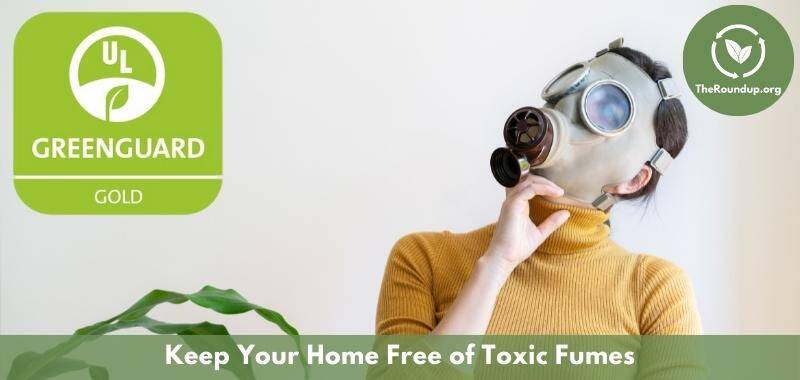
The Environmental Protection Agency (EPA) states that the air inside our homes can be up to five times more polluted than the air outside.
That’s pretty concerning, especially considering how much time we spend indoors (approximately 95%, according to the EPA).
The main culprits of indoor pollution are VOCs (volatile organic compounds). VOCs are carbon-based chemicals that break down into gas form and disperse into the air.
VOCs are most common in cleaning products, paint, and building materials. However, many other everyday household items (home furnishings, sleep surfaces, living room suites, etc.) can also release harmful chemicals into the air.
As discussed in my How Long Does It Take For Furniture To Off-Gas article, VOCs and SVOCs (semi-volatile organic compounds) can lead to a wide range of health issues, such as:
That’s why it’s essential to be aware of products' certifications before bringing them into your home.
Doing your research can help create a healthy indoor environment for yourself and your family.
So, what is GREENGUARD Gold? Let’s take a closer look…
GREENGUARD Gold is an environmental certification developed by the UL (Underwriters Laboratories). It’s designed to help reduce indoor air pollution and improve the quality of the air that we breathe.
It started in 2005 as the GREENGUARD Children and Schools Certification Program, focusing on certifying products for daycares, schools, and healthcare facilities.
The name was changed to GREENGUARD Gold In 2011, and the scope broadened to include the following:
To be certified, products must meet stringent standards for chemical emissions. These standards are some of the toughest in the world and are based on extensive scientific research.
Only products that meet the criteria for GREENGUARD Gold certification can display the logo on their packaging or website. This makes it easy for consumers to identify low-emitting products that are safe for indoor use.
GREENGUARD Gold certification is awarded on a pass/fail basis. Products that meet the standards “Pass”, while those that don’t make the grade “Fail”.
Products carrying the certification are listed on the UL SPOT database. This is an online database that consumers can use to search for products that meet specific criteria.
Products that want to be GREENGUARD Gold certified must undergo extensive third-party laboratory testing.
The products are subjected to a series of tests that measure their emissions of VOCs (volatile organic compounds). These tests simulate real-world conditions, such as temperature and humidity.
GREENGUARD Gold certified products must meet strict emission limits for VOCs. UL sets these limits based on extensive scientific research.
Once a product has been certified, the manufacturer can display the GREENGUARD Gold logo on their packaging or website.
The UL GREENGUARD certification program comes in two levels, GREENGUARD and GREENGUARD Gold. So, what’s the difference between the two?
Both test for over 10,000 chemicals and VOC emissions. The main difference is in the emission limits that products must meet.
The Gold certification has stricter emission limits than the standard GREENGUARD certification:
There are many consumer benefits of certification, including:
Consumers can use this certification in a number of ways, the main one being to ensure the safety of the product they are buying.
One great example of when to look for the GREENGUARD label is when choosing a sleeping environment for your baby or toddler. Getting a GREENGUARD-certified crib mattress would ensure your child is not breathing in any harmful chemicals while they sleep, and give you valuable peace of mind.
It's not just for kids' products, however. Adults need to avoid toxins too, which is why GREENGUARD-certified adult mattresses are also a popular choice among eco and health-conscious consumers in 2026.
GREENGUARD Gold certification doesn't just benefit consumers, though. It is also good for manufacturers.
Having this label shows that GREENGUARD-certified furniture companies are committed to producing products that are safe for indoor use and that they are willing to invest in the necessary testing and certification.
This can help to give manufacturers a competitive edge as more and more consumers become aware of the importance of reducing indoor pollutants.
One of the main downsides is the cost. The certification process is expensive and can only be afforded by larger manufacturers.
Many small businesses and start-ups cannot get their products certified. So for example, some brands that sell genuinely chemical-free sofas may not have the label until they become better established and can afford the cost.
Another downside is that the certification only applies to indoor products. Many outdoor products, such as building materials and patio furniture, cannot be certified.
Finally, the fact that GREENGUARD Gold is a pass/fail certification is seen by some as a significant downside.
Let's say you buy a new GREENGUARD-certified bed frame, for example. It's comforting to know that because your new frame is certified by GREENGUARD, the level of VOC is less than 220 μg/m3. However, it would be even better to know the exact VOC level.
Some manufacturers will tell you the exact VOC levels if you contact them, but it’s not something they have to declare if they don’t want to.
There are some general things you can do to reduce your exposure to VOCs and other indoor pollutants:
The standard GREENGUARD certification does not test for Phthalates. However, GREENGUARD Gold does.
Floorscore has the same VOC limit as GREENGUARD (500 μg/m3).
Yes, ideally, if you want the highest standards in air quality for your baby's sleep environment.
Infants are particularly susceptible to chemical exposure and the effects of breathing in VOCs.
For peace of mind that the air in your nursery is low in VOCs, look for a crib mattress that is GREENGUARD Gold certified.
LEED (Leadership in Energy and Environmental Design) is a green building rating system, while GREENGUARD certified is an environmental certification.
LEED looks at the whole building, while GREENGUARD specifically looks at VOCs and chemicals in products within the home.
The GREENGUARD Gold certification is one of the most reputable in the market.
It ensures you’ll experience low chemical emissions but doesn’t necessarily guarantee 100% clean air (even GREENGUARD certified products can emit some level of chemicals).
Whatever you buy (GREENGUARD Gold Certified or not), It’s always best to unpack outside and allow off-gassing to occur for as long as possible before moving the item into your home.
Other best practices, such as getting as much fresh air into your home as possible and keeping indoor plants, also help reduce VOC chemical exposure.
So, there you have it…everything you need to know about this well-known eco-certification.
If you’re looking for low-emitting products that are safe for indoor use, be sure to look for the GREENGUARD Gold logo.
And if you want to be sure that you’re looking at the most up-to-date information, use the UL SPOT database.
Are you concerned about VOC chemical exposure in your home? Are you willing to spend more on a GREENGUARD Gold certified product with lower chemical emissions?
What was the last product you bought that carried the GREENGUARD certification? Drop me a line and let me know.