
TheRoundup is reader-supported. We may earn a commission when you make a purchase via links on this site, at no cost to you.
All products are reviewed in accordance with our Review Methodology.

Eco-friendly dinnerware is a sustainable alternative to traditional ceramic or plastic tableware. Modern eco-friendly dinnerware sets are made from renewable materials like bamboo, sugarcane, and palm leaf, and durable materials like ceramic and recycled stainless steel.
As a result, sustainable dinnerware has a lower environmental impact and lasts a lot longer. It's also non-toxic, unlike some cheap imported dinnerware, which has been found to contain lead, cadmium, and melamine.
But greenwashing is rampant in the dinnerware industry, making it difficult for consumers to identify truly eco-friendly products.
We tested 27 sustainable dining sets from different brands and picked out the best eco-friendly options for everyday use, dinner parties, picnics, outdoor dining, and more.
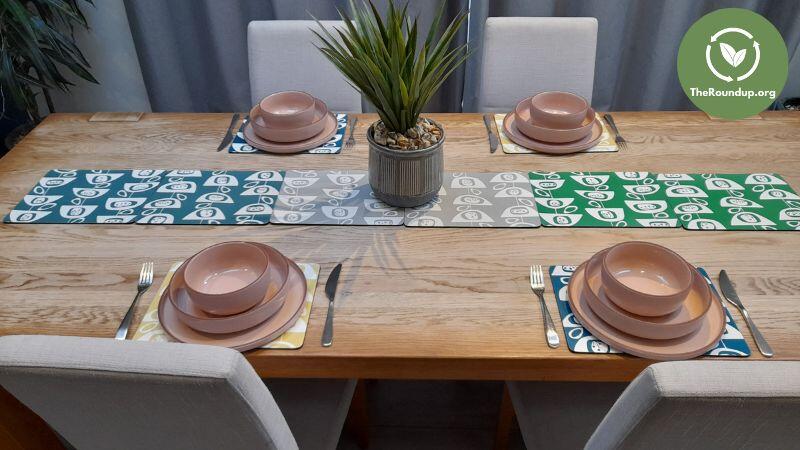
Our top pick works for any occasion and has pride of place on the Miller dining table today...
✔ Everyday Use
✔ Dinner Parties & Formal Events
✔ Sustainable and Durable
Why it's Best Overall: Our Place offers an extensive range of high-quality, eco-friendly dinnerware, non-toxic cookware, and helpful kitchen tools. The combination of quality and affordability means it works well for formal occasions or everyday use.
Our Place dinnerware is made from scratch-resistant ceramic stoneware with a hand-glazed finish that looks simply stunning!
I tested the Dinner Plates, Dinner Bowls, and Soup Bowls. All these items are sold individually or as part of a set, which saves you up to $190 on the individual purchase price - great if you're on a budget.
The hand-glazed scratch-resistant surface feels very robust, and I have no doubt it will stand up to the rigors of daily use.
The entire range, including the items I tested, is dishwasher safe, microwave safe, oven safe (to 350°F), and fridge and freezer safe.
Our Place makes beautiful dinnerware suitable for any occasion. Their sustainable dishes, plates, and bowls are restaurant-grade quality, so they are perfect for dinner parties or formal events. At the same time, they're so durable that they're suitable for everyday use as well. We use them for both and have received plenty of compliments from our friends and family.
Both of the Our Place dining sets stack together for easy storage, even in small spaces. This makes them suitable for small apartments as well as larger family homes.
Free U.S. shipping is available on all orders over $50.
Orders arrive quickly (stock level permitting), securely, and beautifully packaged in sustainable cardboard that’s tape-free (thanks to the clever interlocking design) and fully recyclable.

✔ MADE SAFE certified
✔ Thicker than Regular Stainless Steel
✔ Choice of 3 Colors
Why it's Best for Kids: Ahimsa dinnerware is designed by pediatrician Dr Manasa Mantravadi, with no sharp corners or edges. The thick stainless steel is extremely durable and almost impossible to break or bend. The entire range is free from plastic, BPA, lead, PVC, phthalates, melamine, and any other chemical coatings or finishes.
The most important considerations for kids' tableware are that it should be safe, completely non-toxic, durable, and easy to clean. Ahimsa ticks all those boxes and more.
The range includes plates, bowls, cups, and cutlery, all available individually or in sets. The whole range is made from food-grade stainless steel, and the plates, bowls, and cups are MADE SAFE certified non-toxic.
We decided to test Ahimsa dinnerware in one of the most challenging scenarios I could think of - my niece Gracie's 6th birthday party! The kids loved the bright colors, and the adults were impressed by how the tableware stood up to the predictably rough treatment the kids gave it. Better still, the fact that it's all dishwasher safe means it was easy to clean up afterwards.
Ahimsa claims its products are virtually indestructible, and under normal use, I would agree. The stainless steel feels genuinely thicker than that used by other brands. I could destroy it if I wanted, but I'd need power tools.
Stainless steel, by its nature, is prone to light scratching. I expect some scratching to accumulate in time, but this in no way impacts the usability or safety of the product. It's also not suitable for microwaving, but I would use other cookware for that purpose if needed.
The 9" plate size is large enough for adults to use as well, especially for salads or sandwiches. So overall, I feel this is a safe, chemical-free product that genuinely will last a lifetime.

✔ Biodegradable Natural Materials
✔ Thick, Sturdy & Reusable
✔ Non-Toxic & BPA-Free
Why they're the best compostable plates: We also tested other brands of compostable plates, including Repurpose. We found Gezond plates are stronger and of much better quality, without the sagging that we sometimes found with other brands.
Gezond compostable tableware is entirely plant-based, with plates made from 100% sugar cane fiber and utensils made from cornstarch. It's the perfect sustainable solution for outdoor use, such as picnics, parties, barbeques, or food trucks.
We tested the 350-piece compostable dinnerware set. It contains everything you need to serve up to 50 guests, including 9-inch dinner plates, 7-inch dessert plates, utensils, cups, and straws.
You can buy just the plates on their own if you don't want an entire set. They work out at just 17c each for the 9" plates, compared to 41c for Repurpose 9" plates. So I feel that Gezond is of better quality and better value for money.
The plates are microwave and freezer-safe, heat-resistant up to 248°F, oil-resistant, and leakproof. The set is OK Compost Home Certified (see FAQs for details). It meets ASTM D6400/D6868 compostability standards and is suitable for home composting. Ours started to break down in around 3-4 months.
The plates are far sturdier than regular paper plates, and when we used them, they never seemed to get soggy or fold, even when loaded with heavy foods. They're also washable and reusable, which most other paper plates are not.

✔ Simple, Elegant Design
✔ Eco-Friendly Manufacturing
✔ Affordable
Why they're Best for a Family of Four: Public Goods offers restaurant-grade ceramic dinner plates, lunch plates, mugs, and bowls. All of their range are sold in sets of four, which makes them ideal for family use.
The Public Goods sustainable dinnerware range is made from high-fire porcelain using eco-friendly co-generation technology. This manufacturing process captures waste heat from kilns and uses it to dry clay and generate electricity, so no energy is wasted.
The bowls and plates are non-toxic and contain no lead or plastic materials. Each plate withstands dishwasher cleaning, microwave heating, oven temperatures up to 350°F, and freezer storage.
There is only one color choice, white, so if you are looking for a more lavish design, then this isn't the right product range for you. However, customer feedback suggests the look is popular, and we found the minimalist all-white design suits everyday family meals.
Public Goods states that their dinnerware offers hotel-grade durability and resists chipping and breaking with regular use. They certainly feel very sturdy, and being made from porcelain, I expect them to last a very long time.

✔ 100% Bamboo (No Melamine)
✔ Affordable
✔ Sustainably Grown
Why they're the best bamboo plates: Belari 100% bamboo plates don't break if banged or dropped. We tested dropping the plates 5 times from 3ft onto a hard kitchen floor and saw no visible signs of damage.
They're also lightweight and easy to carry. Although they're not officially rated as scratchproof, they do stand up well to repeated use and rarely mark or scuff.
Belari sells a range of reusable bamboo dinnerware, including square plates and bowls, round plates and bowls, and serving platters.
Bamboo tableware is lightweight but still feels sturdy. It's suitable for everyday use or for travel and outdoor events. The natural look gives a pleasant aesthetic and complements most table settings, although I would not personally use it for more formal occasions.
I tested some other so-called bamboo brands like Ekobo, but found that Belari dinnerware is better because it is made from 100% bamboo, whereas Ekobo products (according to their product specifications) contain a melamine binder. I'll discuss the potential safety concerns regarding melamine later, but suffice to say I only recommend products that are melamine-free.

✔ Zero-Waste Production
✔ Artisan Made
✔ Elegant Style
Why they're the Best Recycled Tableware: Fable makes zero-waste, non-toxic dinnerware using upcycled and recycled materials across its entire product range.
This is an ethical dinnerware brand that manufactures all ceramics from locally sourced and recycled clay at their zero-waste facility in Portugal. 100% of production waste gets reincorporated back into manufacturing.
Their product line includes dinner plates, salad plates, bowls, cups, and carafes, all hand-finished by Portuguese artisans.
We tested their 12-piece Dove Gray dinnerware set, which looks elegant and feels incredibly robust. The brand also produces glassware containing approximately 50% recycled content.
Every piece is dishwasher, microwave, and oven safe up to 450°F. This B Corporation certified company proves it is possible to use recycled materials to create beautiful, durable tableware without sacrificing quality or aesthetic appeal.
We spent six months researching and testing 27 different dinnerware brands to find the best sustainable options for this guide. My wife and I handled most of the testing at home, with additional feedback from friends and family during dinner parties and casual meals.
We started by researching each brand's sustainability claims, manufacturing processes, and material certifications. Then we ordered sample sets and put them through real-world use in our kitchen.
Here are the key criteria we used in our tests.
We used each dinnerware set multiple times over several weeks, washing them according to manufacturer instructions and monitoring for chips, cracks, scratches, or other signs of wear.
We rejected over 20 brands that did not meet our standards. No brand featured in this article paid for inclusion or placement on our list. Our recommendations are based entirely on our independent testing and evaluation.
To identify lead-free or non-toxic dinnerware, look for these three signals.
Don't trust "lead-free" labels alone on cheap imported dinnerware. The FDA has flagged imported pottery sold with "lead-free" labels that still leached lead, so the label carries weight only when paired with material transparency or third-party results (FDA).
Avoid the following categories the FDA flags as highest risk.
For pieces you already own, a home lead test kit works as a useful screening tool. Independent testing has shown it reliably flags dinnerware that exceeds FDA limits, though not the stricter Prop 65 threshold (Sheets, 1999).
If you need more help choosing the perfect material, we'll now look at the alternatives in more detail.
The most sustainable and least toxic dinnerware materials are sugarcane, corn starch, and bamboo for disposable dinnerware, or stoneware, porcelain, and glass for reusable dinnerware.
The table below shows how these materials compare with unsustainable plastic-based alternatives from an environmental and chemical safety perspective.
| Material | Biodegradation Time | Chemical Safety | Durability | Cost | Recyclable | Environmental Impact |
|---|---|---|---|---|---|---|
| Stoneware | Never (inert) | Excellent | Excellent | Moderate | No* | Low (reusable) |
| Porcelain | Never (inert) | Excellent | Excellent | High | No* | Low (reusable) |
| Tempered Glass | Up to 20,000 Years | Excellent | Excellent | Low to Moderate | Yes | Low to Moderate |
| Stainless Steel | Never | Very Good | Very Good (can scratch) | Low to Moderate | Yes | Low to Moderate |
| Sugarcane & Corn Starch | 156-92 days** | Good | Variable | Moderate | No | Very Low |
| Bamboo | 80 days (90% degraded) | Excellent | High | Moderate | No | Very Low |
| Polystyrene (PS) | Never | Poor (leaching when heated) | Excellent | Very Low | Limited | High |
| Polypropylene (PP) | Never | Fair (can leach BPA when heated) | Excellent | Low | Yes | High |
* Ceramics are technically not recyclable in standard recycling streams, but are infinitely reusable.
** Time varies based on starch content - higher starch content degrades faster.
Based on the comparison above, the most sustainable materials are as follows.
You should avoid eating from the following materials wherever possible.
Here's why you need to avoid wheat straw plastic and any other dinnerware that contains melamine.
As well as being harmful to the environment, some traditional dinnerware sets can contain harmful substances like lead, cadmium, BPA, and phthalates that can leach into food.
This can lead to potential health risks, including the following.
Traditional pottery isn't the only type to watch out for. Many wheat straw dinnerware products marketed as eco-friendly may still contain melamine, which is potentially harmful.
There are potential health concerns with bamboo fiber and wheat straw plastic dinnerware because many such products are mixed with melamine resin.
Studies show that this type of product can release small amounts of melamine and formaldehyde when heated or when exposed to acidic foods.
Some regions, such as the Netherlands, have banned the sale of bamboo fibre crockery containing melamine. But for now, it remains on sale in the US.
If wheat-straw dinnerware is actually a melamine-formaldehyde resin filled with plant fibers, then the health concerns above apply. Avoid microwaving and prolonged contact with hot or acidic foods to minimize melamine/formaldehyde migration.
If an item is truly made from a different polymer (for example, polypropylene or PLA with straw fiber) and not melamine-based, these melamine-specific concerns do not apply. Unfortunately, many products don’t clearly disclose the resin type, so it is difficult to be sure what you're buying.
The best way to be certain you avoid exposure to melamine and other potentially harmful chemicals is to choose sustainable tableware options made using non-toxic materials. All of the brands I have recommended above are melamine-free. This was a prerequisite for inclusion in this list.
We have identified stoneware, porcelain, sugarcane, corn starch, solid bamboo, and palm leaf as sustainable dinnerware materials. But how do they compare to each other?
Each material carries a different environmental footprint. To help you choose which is best for you, the table below compares each material in terms of production impact, reusability, and end-of-life sustainability.
Environmental Impact Comparison of Common Dinnerware Materials
| Material | Environmental Impact | Best For | Watch Out For |
|---|---|---|---|
| Stoneware | Made from natural clay and fired at very high temperatures (around 2200°F / 1200°C). Production is energy-intensive, but the plates last for decades, so the impact per use becomes very low when reused regularly (Tufts University LCA). | Everyday reusable dinnerware that will be used for many years. | Sustainable when reused often; high initial energy footprint. |
| Porcelain | Similar to stoneware but fired even hotter (up to 2550°F / 1400°C). Slightly higher manufacturing emissions, but also extremely durable and long-lasting (UNEP Tableware Report, 2021). | Long-term reusable dinnerware with a smooth, durable finish. | Energy-intensive to produce, but high durability lessens long-term impact |
| Tempered Glass | Manufacturing is energy-intensive, but increased durability and lifespan make it a sustainable long-term choice. Fully recyclable at end of life with no loss of quality. | Everyday family use | Recycle only through specialized channels, not standard glass recycling |
| Stainless Steel | Medium to high carbon footprint when virgin materials are used, but 33% to 67% lower when recycled content is used. High (95%) recycling rate and durability make it a sustainable choice over the long term. | Heavy everyday use, families with children, camping, outdoor use | Scratches easily, not suitable for high-acidic food such as tomato sauces |
| Sugarcane Fiber (Bagasse) | Made from the leftover pulp after sugar extraction. Uses agricultural waste instead of virgin resources and breaks down within months in commercial composting. Lower fossil-fuel use than paper or plastic (UNEP). | Single-use settings where composting is available (events, catering). | Still disposable; composting access is essential for low impact. |
| Corn Starch (PLA Bioplastic) | Made from fermented plant sugars. Lower fossil-fuel footprint than plastic, but only compostable in industrial facilities that reach high heat. In landfill or home compost, it behaves like plastic (UNEP). | Short-term use in outdoor areas such as parties, camping, and picnics | Home compostable if certified (See FAQ) |
| 100 % Bamboo (Solid or Pressed) | Made from natural bamboo culms or sheets with no resin binders. Bamboo grows extremely fast and can be harvested annually without replanting. It's a renewable resource with moderate processing energy (FAO; INBAR). | Everyday reusable dinnerware that is lightweight, durable, and biodegradable at end of life. | Confirm it’s 100 % bamboo with no melamine binder due to health concerns (See above) |
| Palm Leaf | Made from naturally fallen leaves pressed with heat. No trees are cut, and no coatings are needed. A comparative LCA found that palm-leaf plates had a higher carbon footprint than paper plates due to long-distance shipping and the use of fossil fuels (UNEP). | Compostable single-use plates and bowls for local or regional sourcing. | Transport footprint increases sharply when imported over long distances. |
Having chosen the material that best meets your needs, here's how to care for your dinnerware so that it lasts as long as possible.
To extend the lifespan of eco-friendly dinnerware, it is recommended to clean gently, store properly, and follow manufacturer-specific care guidelines.
The following tips offer some useful general guidance.
For all materials, I recommend you skip abrasive cleaners, steel wool, or harsh chemicals. Clean promptly after use to prevent staining. Store with padding between stacked pieces. Keep in dry environments away from extreme temperatures.
Dispose of eco-friendly dinnerware by composting, donating, reusing, or recycling, depending on what material your set is made from.
Make sure you remove food residues before composting or recycling. Greasy or heavily stained biodegradable items may require landfill disposal if cleaning proves ineffective.
Contact local waste management authorities for specific guidelines. Disposal infrastructure varies significantly between municipalities, affecting acceptance criteria for various eco-friendly materials.
Compostability labels tell you how and where a dinnerware product breaks down.
For most people, OK Compost Home is the best certificate because it shows that the product will break down in ordinary household composting conditions.
Eco-friendly tableware is generally more expensive than conventional alternatives, but it delivers better value for money over the long term.
Basic non-toxic dinnerware sets start around $30, premium options can cost $100-200, depending on what's included.
Plates made from ceramic, 18/8 or 304 food-grade stainless steel, tempered or borosilicate glass, porcelain, sugarcane, or pure bamboo are all microplastic-free.
Avoid conventional plastic plates or any plates containing melamine.
Palm leaf dinnerware is created from naturally fallen leaves and is fully compostable.
However, it's not widely commercially available and is more of a niche product at this time. The recommendations above are cheaper and more readily available.
My top pick is Our Place because it does pretty much everything well. The hand-glazed stoneware is sturdy enough for everyday family meals and classy enough to bring out for guests, and the bundled set is hard to beat at this price. It came out as the winner in all my tests, and it sits on the Miller dining table today.
However, if you don't need a full set for adult use, consider Ahimsa for the kids or Gezond for outdoor entertaining. Both fit the bill nicely for those specific jobs, and both passed every test I threw at them.
One last word on melamine. It hides in plates marketed as "bamboo" or "wheat straw" composite, and the main nasties (melamine and formaldehyde) can migrate into hot or acidic food.
Every brand on this list is melamine-free. If you take one piece of advice from this article, make it that.
Our core values mean we always prioritize sustainability over profit. We carefully research and evaluate every product to ensure they meet our high standards. All products featured in this article are recommended in accordance with our Review Methodology.
TheRoundup.org - As Seen On

