TheRoundup is reader-supported. We may earn a commission when you make a purchase via links on this site, at no cost to you.
All products are reviewed in accordance with our Review Methodology.
The latest mattress industry statistics are compiled using the latest official 2026 data and market research reports.
Our research offers easy-to-understand infographics and all the latest data on both the US and the global mattress market.
This report reveals the latest data on online mattress sales, sustainability and recycling, the hospitality mattress industry, plus random facts that most people don't know.
This infographic shows statistics on the current size of the global mattress industry market, its major players, consumer demographics, and forecast growth.
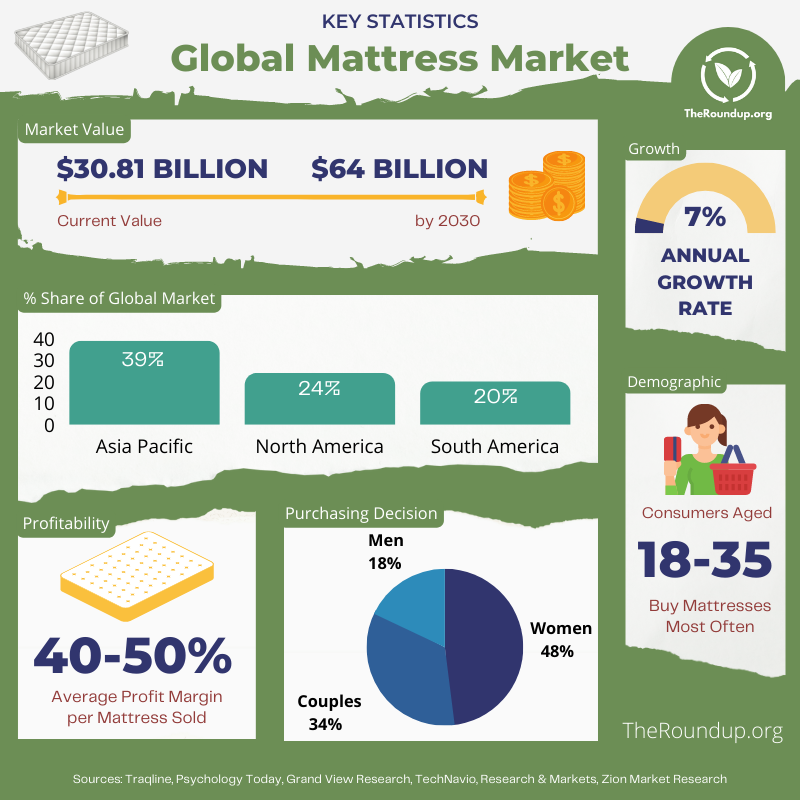
The current global mattress market size is $57.5 billion.
(Fortune Business Insights)
The mattress industry is predicted to enjoy a CAGR (Compound Annual Growth Rate) of around 7.41% up to 2034.
Estimates suggest the global mattress market will be valued at $107.53 billion by 2034.
Increasing consumer awareness around the health benefits of sleep is one of the main factors driving these market trends.
(Fortune Business Insights)
North America is the region with the most mattress demand globally, with a 31.94% share of the global market.
Asia Pacific is the fastest-growing region at 8.10% CAGR, with demand driven by the high population in both China and India.
(Fortune Business Insights)
Consumers aged between 18 and 35 years replace their mattresses most often.
This is because they are more likely to experience major life events such as moving house, marriage, or starting a family - all of which are likely to lead to a mattress purchase.
(Grand View Research)
Yes, the mattress industry is profitable, with profit margins commonly around 40-50%.
These markups mean that a mattress selling for $1000 may have cost around $600-700 to make and ship.
Most new mattresses are made to order, so mattress stores hold very little stock, which keeps their overheads low. Online mattress companies don't even need a showroom, which means their profit margins can be higher still.
(Psychology Today)
Somnigroup International is the world's largest bedding company. Somnigroup International formed in February 2025 when Tempur Sealy bought Mattress Firm, and the group now has roughly $8 billion in pro forma 2025 sales.
Sealy is the top-selling brand with a 15% unit share.
The Suibao Group (China) and Sheela Foam (India) are two of the other global brands that command significant market share in their regions.
(Somnigroup / OpenBrand)
Women are the main target market for mattresses.
Women make 47% of US mattress purchases on their own. 55% of all mattress buyers are married.
(OpenBrand)
This infographic shows the key industry statistics for the US market.

39.7 million mattresses and foundations are sold every year in the US, with a wholesale value of $9.8 billion, according to the latest mattress industry sales data.
(ISPA)
There are 314 mattress manufacturers in the US in 2026.
There are a further 15,261 mattress retailers and stores.
(IbisWorld)
PlushBeds, Avocado, Brentwood Home, Birch, Eco Terra, My Green Mattress, Spindle, Wink Beds, Ashley, Tempur-Pedic, and Sealy all make their mattresses in the USA.
Many of these are eco-friendly mattress brands that use organic and sustainable materials, and make mattresses for all adult bed sizes. These are better for your health and for the environment.
Buying a mattress made in the USA ensures that it meets US regulations and quality standards, many of which are more stringent than those in other countries such as China.
It is kinder to the environment as it cuts down on emissions from shipping, and it also helps the US economy by supporting local jobs.
(TheRoundup)
The #1 selling mattress type in America is the innerspring mattress, which accounts for 44.72% of the US mattress market by value in 2025.
Globally, foam is the most popular mattress type, accounting for 38.75% of the global market.
(Mordor Intelligence / Fortune Business Insights)
Adjustable-air mattresses have the highest customer satisfaction of any mattress type, with 80% of owners satisfied.
(Consumer Reports)
The two leading mattress sellers in the US are Mattress Firm and Amazon.
(OpenBrand)
The average American spends $763 on a new mattress.
The average price of a queen-size, synthetic traditional innerspring mattress is $1,050. A queen-size latex mattress costs an average of $3498.
Mattress prices can range between $300 and $5,000 depending on their size, quality, and the materials it is made from.
(OpenBrand / TheRoundup)
The US mattress industry employs 141,697 people across retailing and manufacturing in 2025.
(IbisWorld)
US federal law requires every mattress sold in the United States to pass two flammability tests.
However, some people are concerned about the side effects of chemicals used in flame retardants added to synthetic mattresses. This is one of the factors driving the popularity of organic mattress brands.
All crib mattresses manufactured or sold in the U.S. must comply with the federal safety standard 16 CFR Part 1241.
This includes tests for firmness, fit, thickness, and coil spring safety (if applicable).
Chemical safety tests are limited to lead (with a maximum permitted level of 90 ppm) and certain phthalates (with a maximum level of 0.1%).
Consumers wanting higher chemical and material safety standards often purchase GOTS and GREENGUARD Gold certified crib mattresses because these independent certifications place strict limits on chemical content and emissions.
The COVID pandemic led to a surge in consumers purchasing mattresses online, but the sector was growing already.
These statistics reveal the current state of the global mattress industry online, and projections for its future.
Consumer attitudes are shifting towards online mattress sales, but in-store purchases remain more popular.
(Better Sleep Council / OpenBrand)
There are around 175 "bed in a box" online mattress companies as of 2019. (CNBC)
However, despite what some people might claim, they are not all the same.
Whilst it is true that many have similar branding and products, there are big differences between those online mattress companies that sell non-toxic bed-in-a-box mattresses and those that sell synthetic ones, in terms of both price and quality.
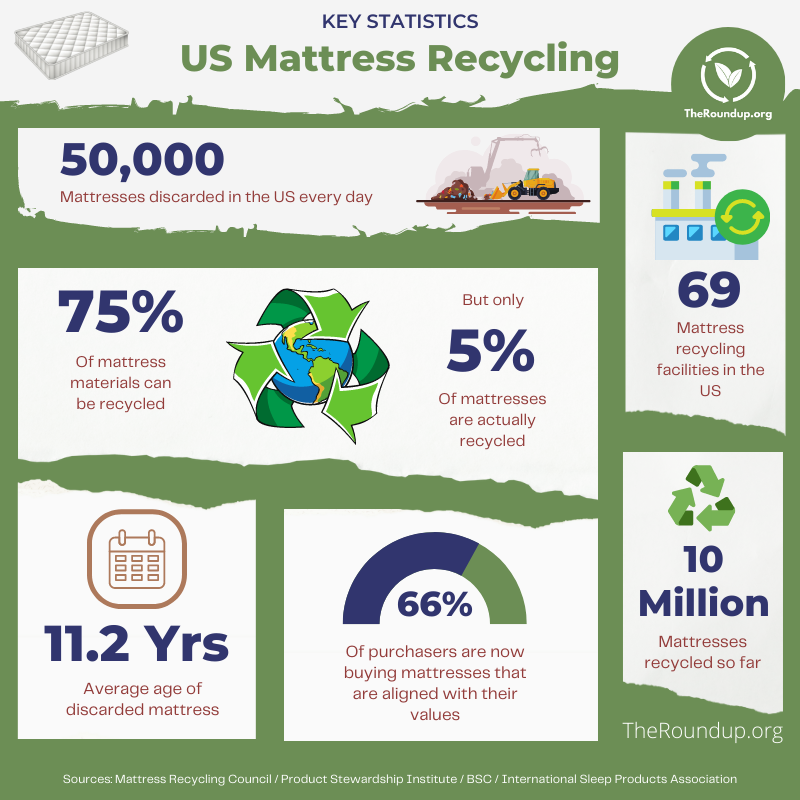
Whenever a consumer or business buys a new mattress, the question arises of what should be done with the old one.
Unfortunately, the statistics illustrated by the infographic below show that whilst most mattresses can be recycled, far too many still go to waste.
(Mattress Recycling Council / Product Stewardship Institute)
Recycling old mattresses is free for households and businesses in California, Connecticut, Rhode Island, and Oregon, where a recycling fee added to every new mattress sold pays for the drop-off sites.
Hotels are a major purchaser in the international mattress market. But what mattresses do they use, and how often are they bought and replaced? You'll find the answers below.
It can vary depending on the type of hotel. On average, hotels replace their mattresses:
Mattresses may be replaced sooner if they are damaged or soiled to the extent that they become unusable.
(TheRoundup)
Marriott uses the Marriott Mattress, which is made in the US by Jamison Bedding.
There are three versions of this memory foam mattress: Supreme, Presidential, and Moxy.
(Marriott International)
Hilton Hotels use mattresses made by Serta.
Different Hilton Brands, such as Canopy and Hilton Garden, have their own mattresses, but the majority of the chain uses the Serenity mattress.
(Hilton International)
Four Seasons uses Beautyrest mattresses made by the Simmons Bedding Company.
(Four Seasons)
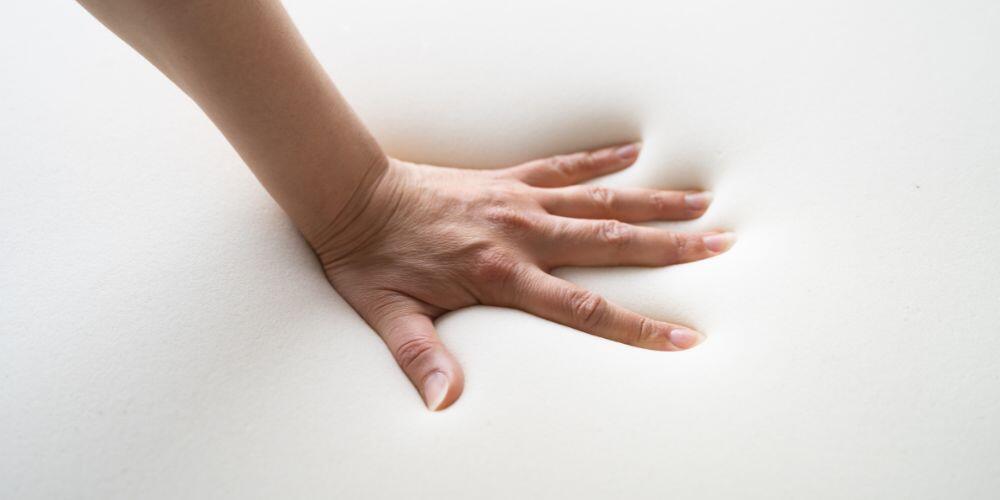
Memory foam is light and easy to transport.
But with a few exceptions, most memory foam on the market is synthetic and made from petroleum-based polymers. It isn't biodegradable, and can emit chemicals and VOCs.
Despite this, it remains highly popular.
We'll end with a couple of random mattress facts that most people don't know.
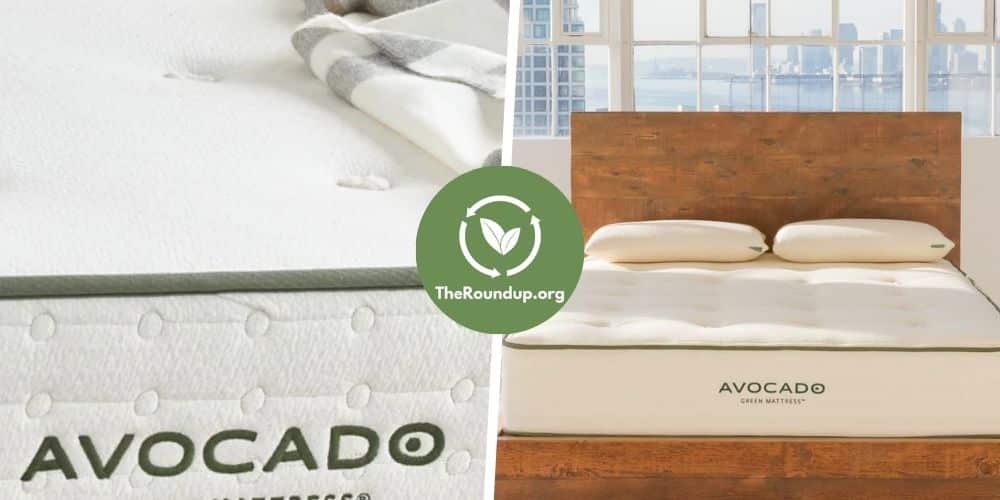
Yes, dense latex mattresses can last for more than 20 years. Avocado offers a 25-year warranty on its products, and PlushBeds offers a lifetime manufacturer's warranty.
Traditional innerspring mattresses are unlikely to last as long unless they are rarely slept on.
No, current statistics show that there are approximately 15,261 mattress retail businesses in the U.S. compared to 16,864 US Starbucks outlets.
(IbisWorld / Starbucks)
The latest facts about the mattress industry reveal that the mattress market size has grown significantly over recent years and is likely to continue to do so in the future. This is true both in the US and across the globe.
Consumer habits are changing, with more people looking to buy online, and factors such as health and sustainability becoming more important.
We also learned that most mattresses can and should be recycled when they reach end of life, but that in practice this is still not happening often enough.
If you would like to use an infographic from this article, they are licensed under Creative Commons CC BY, which means they can be used or distributed as long as they are accompanied by an attribution link back to this page.
Better Sleep Council | CNBC | Consumer Reports | CPSC | Fortune Business Insights | Grand View Research | IbisWorld | ISPA | Mordor Intelligence | MRC | NASA | NCBI | OpenBrand | PSI | Psychology Today | Somnigroup | Starbucks