TheRoundup is reader-supported. We may earn a commission when you make a purchase via links on this site, at no cost to you.
All products are reviewed in accordance with our Review Methodology.
When buying a new organic mattress, you need to consider its weight. Mattress weight matters so you can make sure your bed frame can support it and that you can rotate it for maintenance and cleaning.
Several factors influence how heavy a mattress is, including the following.
To get a more accurate answer than simply saying “It depends,” our team gathered a wide sample of data from the leading organic mattress brands. We used current 2026 data to calculate the official average mattress weight in the US by size and type.
Mattresses weigh between 49 lbs (22.24 kg) for a foam, twin-size mattress and 202 lbs (91.63 kg) for a latex, King or Cal King size on average.
Queen-sized mattresses are the most popular in the US, so it is often helpful to compare material weight for this size. An average Queen organic mattress weighs 81 lbs (36.7 kg) in memory foam, 112 lbs (50.8 kg) as a hybrid, and 156 lbs (70.8 kg) in latex.
The following infographic shows the average weight of an organic mattress, organized by size and type.

The averages are based on our survey of the weight of 27 natural mattresses made by 11 brands.
Mattress weight varies widely by brand, even between mattresses of the same size and type. PlushBeds latex mattresses are the heaviest, with Nectar and Layla among the lightest.
A Queen hybrid mattress weighs between 85 lbs (38.6 kg) and 154 lbs (69.9 kg) depending on the brand and model.
When you buy a natural mattress, it’s unlikely to weigh exactly the average. You also need to know the variance.
The following table shows the full breakdown of the data we collected in our survey. You can see in detail how the weights vary by brand, size, type, and specific model.
All weights are shown in lbs. To convert a weight to kilograms, multiply it by 0.4536.
| Model | Type | Twin | Twin XL | Full | Queen | King | Cal King |
|---|---|---|---|---|---|---|---|
| Hybrid | 76 | 82 | 108 | 114 | 134 | 158 | |
| Hybrid | 95 | 105 | 131 | 154 | 195 | 192 | |
| Hybrid | 62 | 67 | 78 | 94 | 110 | 110 | |
| Hybrid | 59 | 63 | 81 | 91 | 116 | 116 | |
| Hybrid | 56 | 59 | 79 | 100 | 118 | 119 | |
| Hybrid | 80 | 90 | 115 | 135 | 170 | 170 | |
| Hybrid | 80 | 90 | 117 | 128 | 166 | 170 | |
| Hybrid | 80 | 95 | 112 | 123 | 153 | 161 | |
| Memory Foam | 51 | 55 | 72 | 83 | 101 | 98 | |
| Hybrid | 63 | 66 | 84 | 97 | 120 | 119 | |
| Hybrid | 76 | 81 | 103 | 121 | 149 | 146 | |
| Hybrid | 78 | 83 | 102 | 120 | 148 | 144 | |
| Hybrid | 59 | 63 | 84 | 100 | 127 | 126 | |
| Hybrid | 70 | 72 | 85 | 106 | 128 | 131 | |
| Memory Foam | 41 | 44 | 57 | 69 | 87 | 87 | |
| Hybrid | 67 | 78 | 88 | 104 | 128 | 127 | |
| Hybrid | 70 | 75 | 95 | 115 | 140 | 140 | |
| Hybrid | 57 | 62 | 75 | 85 | 115 | 120 | |
| Memory Foam | 39 | 42 | 54 | 66 | 83 | 82 | |
| Memory Foam | 49 | 53 | 69 | 83 | 105 | 105 | |
| Memory Foam | 55 | 59 | 76 | 92 | 116 | 116 | |
| Latex | 104 | 110 | 154 | 172 | 221 | 221 | |
| Hybrid | 72 | 79 | 110 | 120 | 161 | 162 | |
| Latex | 104 | 110 | 154 | 172 | 221 | 221 | |
| Hybrid | 90 | 95 | 100 | 110 | 130 | 130 | |
| Memory Foam | 61 | 70 | 79 | 93 | 116 | 116 | |
| Latex | 80 | 82 | 100 | 125 | 165 | 165 |
Note: All data is correct at time of publication. However, manufacturers’ specifications are subject to change with no prior notice. Therefore we recommend you always double-check the product specifications before you buy.
Mattress weight increases with size. King and California King mattresses weigh around twice as much on average as Twin mattresses of the same type.
The following breakdown shows the average, heaviest, lightest, and most common (mode) weight we found for each standard mattress size.
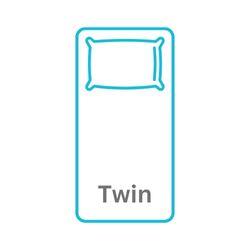
Average
Memory Foam: 49 lbs | 22.22 Kg
Hybrid: 72 lbs | 32.66 Kg
Latex: 96 lbs | 43.54 Kg
Range
Heaviest: 104 lbs | 47.17 Kg
Lightest: 39 lbs | 17.7 Kg
Most Common: 80 lbs | 36.29 Kg
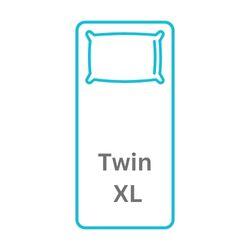
Average
Memory Foam: 54 lbs | 24.5 Kg
Hybrid: 78 lbs | 35.38 Kg
Latex: 101 lbs | 45.81 Kg
Range
Heaviest: 110 lbs | 49.9 Kg
Lightest: 42 lbs | 19.05 Kg
Most Common: 90 lbs | 40.82 Kg
Average
Memory Foam: 68 lbs | 30.84 Kg
Hybrid: 97 lbs | 44 Kg
Latex: 136 lbs | 61.69 Kg
Range
Heaviest: 154 lbs | 69.85 Kg
Lightest: 54 lbs | 24.49 Kg
Most Common: 100 lbs | 45.36 Kg
Average
Memory Foam: 81 lbs | 36.74 Kg
Hybrid: 112 lbs | 50.8 Kg
Latex: 156 lbs | 70.76 Kg
Range
Heaviest: 172 lbs | 78.02 Kg
Lightest: 66 lbs | 29.94 Kg
Most Common: 120 lbs | 54.43 Kg
Average
Memory Foam: 101 lbs | 45.81 Kg
Hybrid: 139 lbs | 63.04 Kg
Latex: 202 lbs | 91.63 Kg
Range
Heaviest: 221 lbs | 100.24 Kg
Lightest: 83 lbs | 37.65 Kg
Most Common: 128 lbs | 58.06 Kg
Average
Memory Foam: 101 lbs | 45.81 Kg
Hybrid: 141 lbs | 63.96 Kg
Latex: 202 lbs | 91.63 Kg
Range
Heaviest: 221 lbs | 100.24 Kg
Lightest: 82 lbs | 37.19 Kg
Most Common: 116 lbs | 52.62 Kg
Innerspring mattresses are the lightest, closely followed by memory foam. Solid latex mattresses are heavier than other types because of the relative density of latex material.
A typical innerspring mattress has a relatively thin padded top layer, with steel coils underneath. Between the coils is just air, meaning that the overall structure is comparatively lightweight.
Very few non-toxic mattresses have a core made of springs alone, which is why our survey does not include an innerspring mattress. An innerspring layer is more common as the support core of a hybrid mattress.
The thick foam layers in a memory foam mattress are designed to conform to your body shape and provide extra support for certain types of sleepers. Memory foam can often be a good option for back pain sufferers.
The more solid nature of a memory foam mattress means it is heavier than an innerspring, but despite its density, the foam is relatively lightweight compared to other materials. On average, the foam mattresses in our survey were lighter than hybrid or latex equivalents of similar sizes.
Hybrid mattresses usually have multiple layers, combining a coil-sprung section with one or more layers of other materials. You may therefore get latex hybrids (on the heavier side) or memory foam hybrids (lighter).
The multiple layering can also make hybrid mattresses thicker, which explains why they are generally heavier than memory foam alone.
Latex is denser than memory foam and therefore weighs more. Organic latex mattresses were the heaviest type in our survey, and they are generally considered to be more durable and more eco-friendly than synthetic memory foam (when GOLS-certified).
Natural latex can trigger a reaction in people with a latex allergy, so we recommend a latex-free organic mattress for people with these sensitivities.
A king-size mattress weighs between 83 lbs (37.6 kg) and 221 lbs (100.2 kg), depending on its materials and brand.
On average, a memory foam King weighs 101 lbs (45.8 kg), a hybrid King weighs 139 lbs (63 kg), and a latex King weighs 202 lbs (91.6 kg).
Yes, a Split King is generally about as heavy as a King. In 21 of the 27 mattresses in our survey, two Twin XL mattresses (a Split King) weigh within 20 lbs (9.1 kg) of one King.
However, the Split King comes in two parts which can be moved separately, so you only have to move or carry half the weight at a time.
You need to know the weight of your mattress to make sure that your bed frame or box spring can support it, and that you are physically able to move the mattress.
If you have someone to help you or you ordered a white glove delivery service, then you may not need to personally carry the mattress into your bedroom. But you’ll still need to move it at some point to clean it, vacuum underneath it, or for regular rotation.
No, a heavier mattress is not always a better mattress, because size, thickness, and type all change a mattress's weight regardless of quality.
Some thin, low-profile mattresses are lighter because of their reduced height, but still made from quality materials.