TheRoundup is reader-supported. We may earn a commission when you make a purchase via links on this site, at no cost to you.
All products are reviewed in accordance with our Review Methodology.
You’ve just taken delivery of a brand-new mattress, and you’re looking forward to getting some good sleep on it.
However, unless you bought a chemical-free mattress, the off-gassing that occurs when the mattress is first unpackaged is probably giving you second thoughts.
That second thought is more than likely searching for ideas to speed up mattress off-gassing so you can catch some sleep.
In this article, I’ll give you practical tips on how to speed up mattress off-gassing that will make your sleep experience odorless in no time.
I’ll also delve a little deeper into precisely what volatile organic compounds (VOCs) are and why they’re lurking in your new mattress.
But first, the tips!
Contents
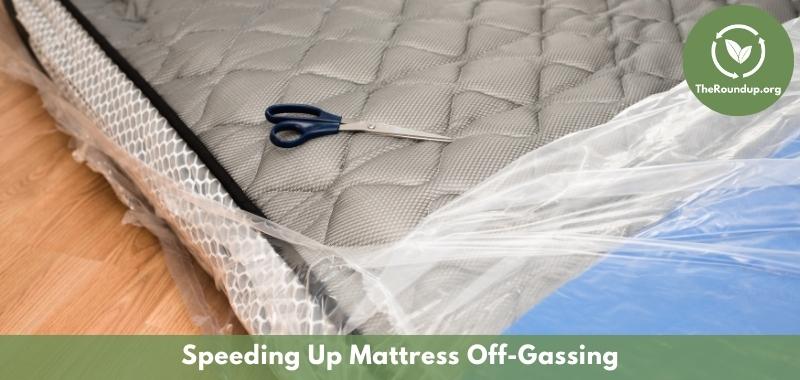
As soon as you take delivery of your brand-new mattress, remove the packaging and air it out in a well-ventilated room for as long as possible (at least 24 hours).
An electric fan will help circulate the new mattress smell and VOCs around the room and out the window.
If the weather permits, take your mattress outside and air it in the sun.
UV can increase outgassing from polymers (Khassanchine et al., 2006). When a mattress is left in full sunlight, the outer textile and any exposed foam would see greater photochemical change than if kept covered indoors. If you have a hybrid mattress with removable layers, remove the foam layer and place that in direct sunlight for maximum benefit.
Just be sure to bring the mattress back inside before nightfall so it doesn’t get wet or soiled by neighborhood cats!
An air purifier can help remove VOCs and other toxins from the air, speeding up the off-gassing process.
Place the purifier in the room where you’re airing out the mattress and run it for 24 hours.
Baking soda is a great way to absorb odors, and it can help speed up mattress off-gassing.
Simply sprinkle baking soda over the entire surface of the mattress and let it sit for at least 30 minutes. Then vacuum thoroughly.
Baking soda is non-toxic and safe for use around children and pets.
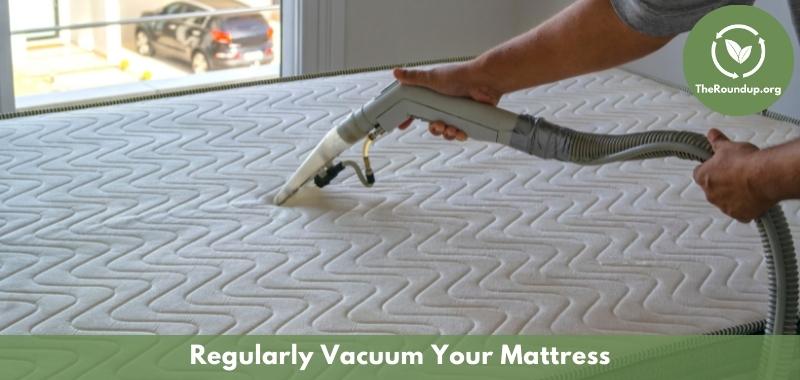
Vacuuming your new mattress multiple times a day during the off-gassing period will help speed up the process.
This is because it will remove any dust or dirt-trapping toxins in the mattress.
Sometimes known as the ’white sock treatment’, jumping on every inch of the mattress for as long as possible can help dislodge the trapped chemicals and release them into your well-ventilated room and eventually out the window.
Two things to watch out for with this method:
If you live in a humid climate, using a dehumidifier can help speed up mattress off-gassing.
The dehumidifier will help remove moisture from the air, preventing the chemicals from being released into the air.
A mattress cover acts as a barrier between you and the mattress surface. It can also help prevent bed bugs, dust mites, and other allergens from accumulating on your mattress.
If you’re concerned about toxins, using an OEKO-TEX mattress protector can help to reduce your exposure.
However, be careful not to use a mattress cover as soon as you unbox a mattress. Doing so can trap some of the toxins for a long time. Always allow a mattress to fully off-gas before reaching for the protector.
Synthetic fragrances can mask the smell of off-gassing, but you might not be able to tell once the process has stopped.
So, avoid using scented candles, air fresheners, or perfumes in the room where the off-gassing mattress is located.
Place bamboo charcoal bags on and around the off-gassing mattress to absorb the VOCs.
To refresh the bags and release the VOCs, simply place them outside in direct sunlight for two hours.
Most mattress manufacturers will have their own specific advice on how to speed up mattress off-gassing.
So, be sure to check the user manual that comes with your mattress. If you can’t find it, contact the company directly, and they should be able to help.
Off-gassing occurs because mattresses are made with materials that contain chemicals. These chemicals can be released into the air when the mattress is unpackaged and exposed to oxygen.
These chemicals (often referred to as volatile organic compounds, or VOCs) come in many forms, including:
You can read more about VOC sources and health implications here.
The length of time that mattress off-gassing lasts depends on the type of mattress you have:
Most mattresses will off-gas to some degree, and it can take anywhere from a few days to a few weeks for the process to be complete.
The low levels of chemicals released by an off-gassing mattress are not generally considered toxic (Beckett et al., 2022).
But whether VOC exposures cause health effects depends on the level and duration of exposure.
They can lead to a variety of short-term issues, such as:
Source: EPA
If you’re looking for a non-toxic mattress with minimal off-gassing, choose one made with natural materials.
Buying certified organic latex mattresses is a good choice as they are made from constituent materials that show minimal off-gassing. The next tip explains the certifications to look for.
Organic hybrid mattresses with organic cotton batting are also low in VOCs.
When buying a new mattress, look for sustainability certifications that indicate low or zero VOC levels.
The most common and well-respected are CertiPUR-US and GREENGUARD. Both certify that products have low volatile organic compounds (VOCs) emissions and are much less likely to cause off-gassing.
If you’re in the market for an organic mattress, look for certifications like Global Organic Latex Standard (GOLS) and Global Organic Textile Standard (GOTS). These certify that the materials in the mattress are organic and sustainable.
If you live in California, you should also look for mattresses displaying Proposition 65 warnings.
I have a feeling this will be a slightly divisive tip, but here goes nothing…
One way to avoid off-gassing from your mattress is to buy a slightly used one.
This means that most of the VOCs will already be released, and you’ll be left with a mattress without the horrible chemical smell.
You can find slightly used mattresses on sites like Craigslist or Facebook Marketplace. Just make sure to inspect the mattress thoroughly before you buy it.
Reading online reviews can help you narrow down which mattresses off-gas and which don’t.
Beware of fake reviews, and don’t fall for any greenwashing tricks.
It depends. If you bought a mattress with a set sleep trial period, you could return it for whatever reason. If there is no set sleep trial period, then you’re at the discretion of the manufacturer/retailer.
Yes. unless you choose an organic air mattress, it will off-gas some of the same chemicals as traditional mattresses, so many of the tips in the article apply.
Yes, but it’ll take longer. The colder the temperature, the slower the off-gassing process.
It depends on your definition of ’safe’. If you’re worried about the long-term health effects of off-gassing, you may want to consider an organic mattress.
However, sleeping on an off-gassing mattress is considered safe if you’re happy to put up with the off-gassing odor and potential mild side effects. However, it’s not something I would recommend doing (especially in the first 24hrs)
So, it turns out there are some scary VOCs potentially lurking in your new mattresses!
Fortunately, the level at which these toxic chemicals are present is unlikely to cause any long-term health issues.
However, why take the chance?
The VOC levels are at their highest when you first open a new mattress.
By following some of the steps highlighted in this article, you should be able to reduce your exposure dramatically.