TheRoundup is reader-supported. We may earn a commission when you make a purchase via links on this site, at no cost to you.
All products are reviewed in accordance with our Review Methodology.
Most people don’t think about eco-credentials when shopping for household goods.
But if you’re reading this article, you’re probably not like most people. You care about the planet. You care about your health. You care about the health of the ones you love.
You might have seen CertiPUR-US mentioned in some of my previous articles, or on eco-friendly brand websites when shopping online.
But have you ever stopped to ask yourself, What is CertiPUR-US Certified? What does it actually do, and why is it important?
It could be the difference between buying a toxic product and a safe one, so this is definitely a label you need to look out for.
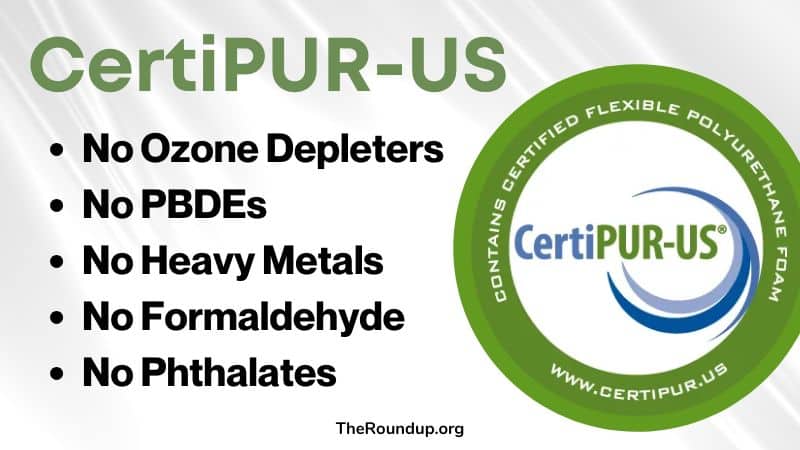
A CertiPUR-US certified foam is a flexible polyurethane foam that has been tested for the following characteristics:
Ozone depleters are chemicals that can damage the Earth’s ozone layer, so their use is strictly regulated.
In 1987, the Montreal Protocol came into being. It mandated that industries eliminate ozone-depleting chlorofluorocarbons (CFCs) by the year 2000.
The CertiPUR-US certification program tests foam for various characteristics, including the presence of ozone depleters.
PBDEs, TDCPP, and TCEP are all flame-retardant chemicals that have been linked to health problems.
Certified foams are prohibited from containing any of the following flame retardants:
Heavy metals (mercury, lead, etc.) are not common in the foam manufacturing process. However, CertiPUR-US still checks for these metals and only certifies foam with no heavy metal traces.
CertiPUR-US laboratory testing subjects foam to analysis at a molecular level so no heavy metals can slip through the net.
Formaldehyde is a chemical that can be released from some types of foam. It’s one of the main contributors to poor indoor air quality.
Phthalates are a class of chemicals that have been linked to health problems.
The Consumer Product Safety Commission (CPSC) regulates some phthalates and requires them to be disclosed on product labels.
CertiPUR-US certified foams do not contain any of the eight Consumer Product Safety Commission regulated phthalates:
All CertiPUR-US certified foam has been tested and certified to produce a VOC level of less than 0.5 parts per million.
The EPA reports that indoor VOC levels are between two and five times higher inside the home than outside.
This is caused by chemical-laden furniture, bedding, etc., off-gassing chemicals into your home.
Choosing certified foam is one way to start stemming the tide of toxins and reducing VOC levels in your home.
The CertiPUR-US program is strict about the claims foam producers can make.
For a company to use the CertiPUR-US logo, its products must undergo rigorous testing and meet all of the applicable criteria.
If a company makes any unsubstantiated claims, it loses its certification.
All products that carry the CertiPUR-US logo are independently lab tested to verify that they meet the certification criteria.
The independent nature of the testing is key to ensuring every product is given a fair chance to make the grade.
Once the CertiPUR-US certification is issued, it lasts for one year. After this time, companies have to go through the testing process again.
This ensures that companies are kept ’on their toes’ and have to keep up their high standards year on year.
Uncertified memory foam is not necessarily toxic. The problem is that without independent testing, there is no way of knowing what chemicals the foam contains.
Some companies make claims about their products being ’safe’ or ’toxin-free’ but offer no third-party verification.
Others may have their products certified by a less stringent program with lower standards.
Check out our Is Memory Foam Toxic guide to find out more about the potential chemical content of synthetic latex and polyurethane foams.
If you want to be sure that the foam in a product is safe, your best bet is to go for something that’s CertiPUR-US certified.
Virtually any product containing foam can carry the CertiPUR-US label, but there are some that I would be particularly keen to see it on.
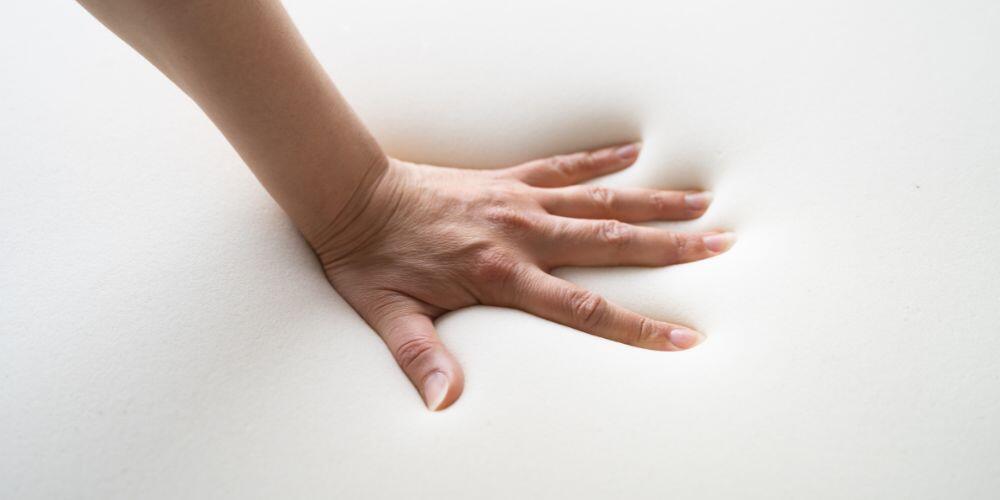
CertiPUR-US is used to certify the foam components of memory foam mattresses and the biofoam components of some hybrid mattresses.
See our guide to organic and non-toxic mattress brands to see which products carry the certification.
Most parents would be horrified if they thought their newborn was being exposed to toxic chemicals, but that's exactly what can happen when your baby sleeps on a synthetic foam surface.
If you want to ensure you have the safest crib mattress, then CertiPUR-US certification is a great way to get confirmation.
Keeping your family safe isn't something that ends when they grow up!
Any other sleep surface that contains foam, such as organic memory foam mattress toppers, would also benefit from being certified non-toxic.
Carrying the CertiPUR-US label confirms that your sleep surface is free of chemical flame retardants and will not emit harmful VOCs while you sleep.
If you're shopping for other soft home furnishings, there's a good chance they have at least some foam.
So any time you're comparing eco-friendly furniture, look out for the CertiPUR-US logo.
CertiPUR-US is not the only certification fighting the good fight against VOCs.
Here's a list of other non-toxic certifications and how they compare to CertiPUR-US.
There is a fee for testing and certification, but the amount varies depending on the number and type of certified products.
The time frame for testing and certification also varies depending on the number and type of products being certified. Generally speaking, it takes around two to four weeks from start to finish.
If a product doesn’t pass the certification criteria, the company has the option to make changes and resubmit it for testing.
There is a certain level of chemicals in almost all products. Polyurethane foams are no exception.
However, buying CertiPUR-US certified polyurethane foams ensures that these harmful chemicals are kept to an absolute minimum.
Therefore, it is a good indicator of a safe material for mattresses or other home furnishings.
No. Certified foam is not a fire hazard. It will not contain any of the harmful flame retardants mentioned in this article, but it will still be flame-retardant. This is usually achieved in a more natural way (a natural barrier of wool, for example) or with less harmful chemicals.
Certified memory foam does not contain fiberglass. However, the memory foam might be in a product with fiberglass added. Always check with the manufacturer if you’re unsure.
Certified foam still traps heat and is therefore not a good choice for hot sleepers.
If you’re a hot sleeper, I recommend you avoid foam mattresses and go for a cooler material, such as latex or wool.
Seeing the CertiPUR-US certification on a product gives you certainty.
The CertiPUR-US certification is strict about what companies can claim, and all products carrying the logo are independently lab tested.
Choosing a product with certified foam is one of the best ways to reduce VOC levels in your home.